Showing posts with label weather and climate. Show all posts

Sunday, June 21, 2015

MWW 58: Зун

Cyrillic
зун
Joa
Transcription
zun
IPA
[tsʊŋ]
Layman’s Pronunciation
DZOONG
Meaning
summer
In Genghis Khan’s time it was jun.

Summer and the Solstice


Today is the summer solstice for 2015, so happy summer! - to the Americans at least. In Mongolia, it has already been summer for quite awhile.

In the U.S. we are used to thinking of summer as starting on the summer solstice (June 20 or 21) and lasting until the autumn equinox (September 20 or 21). If you asked an American, he would probably say the summer months were June, July, and August.

In Mongolia, the school's summer vacation зуны амралт (zuny amralt, summer vacation) runs exactly from June 1 to September 1. Nevertheless, if you asked a Mongolian, he still might say the summer months were May, June, and July, instead of June, July and August. This might be the reason a Mongolian man once told me that summer ended after Наадам (July 11-14: see here).

Even though we chose an astronomical event (the solstice) to begin summer, we chose somewhat arbitrarily. There is a succession of “landmarks” on the journey through the year, and different cultures have different ones that they find useful as signposts for the seasons. The way Mongolians have traditionally viewed the division of the year, the summer solstice marks the middle of summer, not the beginning.

Are you summering well?


Mongolians have several greetings tailored to the seasons. For summer, there's

Сайхан зусч байна уу? (Saihan zusch baina uu?)

which is pronounced rather like "SAKH-ung DZOO-such BAN oo?" and which may be translated as "Are you summering well?" To which the proper response is

Сайхан зусч байна. (Saihan zusch baina.) - I am summering well.

The зусч part here comes from the verb зусах (zusah) "to spend or pass the summer," and зусах is made from зун, with the N disappearing in front of the verb-making suffix -с (-s).


Monday, May 4, 2015

Ögii Lake

As I mentioned before, Khöshöö Tsaidam was only half of my trip. After that, we visited Ögii Lake (Өгий нуур / Ögii Nuur, also spelled Ogii or Ugii). Ögii Nuur is not only a lake, but also the name of the sum (district) which surrounds it. It lies north of Khashaat sum, and along the same road that connects Kharhorin and Khöshöö Tsaidam. Sometimes people from my town went fishing up here, although according to them, the fish aren't as big as the ones in Tariat.

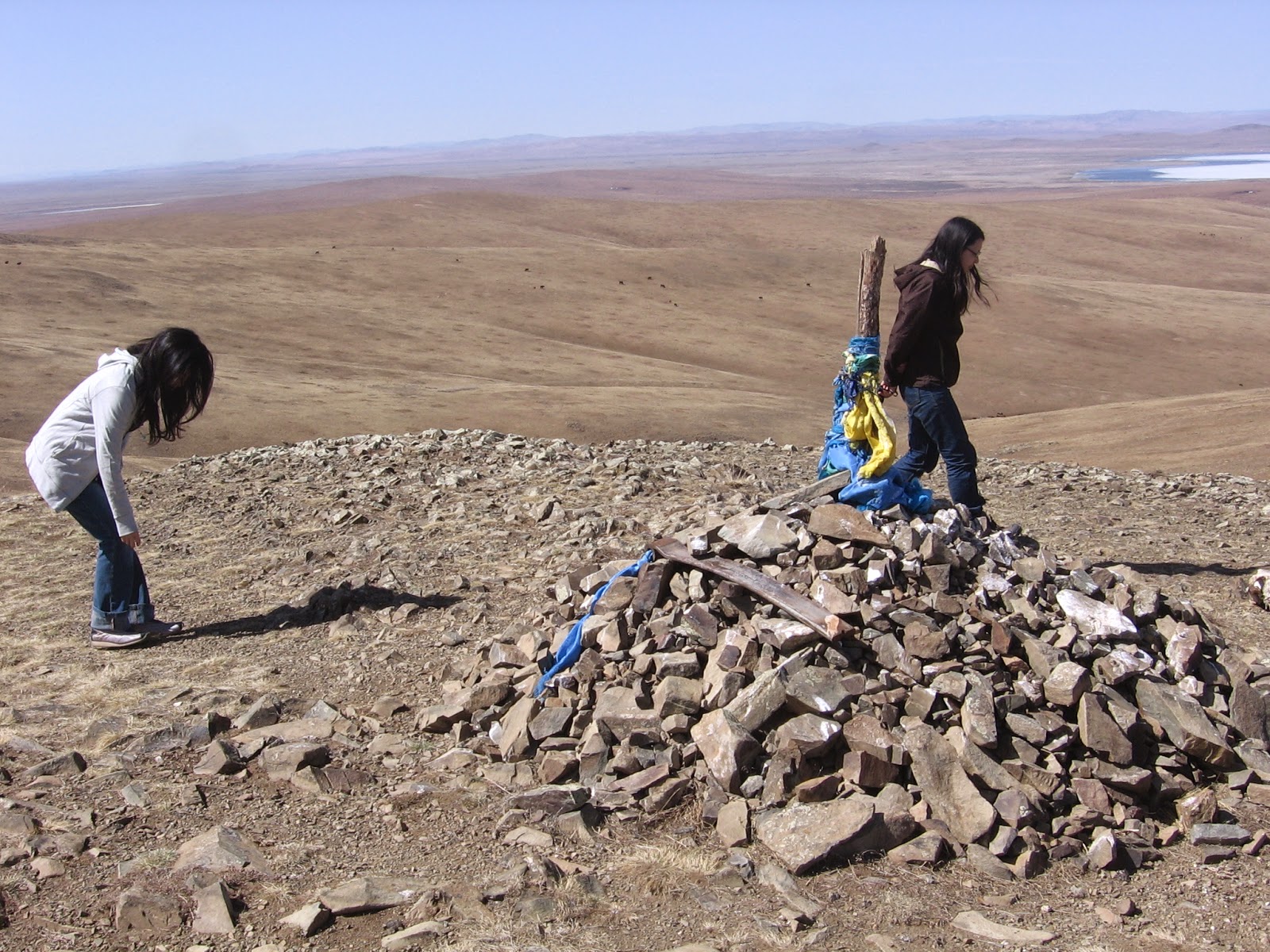
Овоо тойрон явах - Circumambulating the ovoo
On the way we stopped at an ovoo by the lake. Ovoos often mark boundaries, and if you pass one it is customary to attend to them before continuing with your journey. Usually, this requires walking around it clockwise three times and putting three stones on it.

When we got to the lake, it was melting, but the majority of the surface was covered still covered in ice, sometimes all the way to the shore.


It was often thin ice though. I didn't walk carefully enough, and one of my feet plunged through it. I came in my rubber boots, but the water flooded right in and I had to take it off and dry it off. Luckily, Ögii is very shallow, and I would have had to walk further out to get to a place deep enough to drown.

My feet, before they got wet.

The area was largely bare. The village area was farther away, and spring was still waking up. There were some living things around, but sometimes in surprising places. I found a ladybug out on the ice, but when I picked it up, it shook itself off and flew away. I found two live ladybugs just chilling, literally, on the lake.

One of two live ladybugs I found on the lake
Other hardy life forms included weeds, moss, and of course, lots and lots of lichens, which were colored brightly and covered most of one of the promontories.

Lichens
We didn't see the far side of the lake, but it was beautiful enough where we were, and a fine conclusion to the trip.

Ögii Lake

Ögii Lake

Ögii Lake

The other side of Ögii Lake

A small cliff

Sitting on the shore

Another ovoo

Sunday, December 28, 2014

MWW 56: Дэвтэр

How the history of "дэвтэр" reflects the history of writing


Cyrillic дэвтэр

Transcription devter
IPA [ˈteʍ.thɪr]
[ˈteɸ.thɪr]
Layman’s
Pronunciation
"DEFF-tihr"
(or sort of like
"deaf tear")
Translation notebook
In Classical Mongolian it was debter.

In modern times, Mongolian has borrowed the English word "notebook" as нөүтбүк (nöütbük) to refer to a laptop computer. The word doesn't seem to appear in dictionaries yet, but a Google search turns up many pictures of laptops. Instead the Mongolians call their paper notebooks дэвтэр, which can also refer to a notepad, ledger, log, journal, or diary. There are зургийн дэвтэр (zurgiin devter, "sketchbook"), and I once had a Mongolian-Chinese ярианы дэвтэр (yariany devter, "phrase book"). But despite its mundaneness, дэвтэр has had quite an adventure getting to Mongolia.

The Notebook's Journey Around the World


Similar words for notebooks are found in Turkic languages: Kazakh дәптер (däpter), Kyrgyz дептер (depter), and Uzbek daftar. These words came from either Arabic دَفْتَر (daftar) or Persian دفتر (daftar). Arabic and Persian seem to have taken it from Aramaic דפתרא / ܕܦܬܪܐ(dptr), which in turn came from Greek διφθέρα. [1] My guess is that the direct ancestor to дэвтэр is Uyghur دەپتەر (depter), since the Mongolians also took their traditional script from Uyghurs. The Uyghur script was adapted from the Sogdian script, which was adapted from the Aramaic script - similar to дэвтэр itself. (The Uyghurs have abandoned this script in favor of the Arabic alphabet.)

Greece to Mongolia is a long way for дэвтэр to go, but it has gone much further than that. Under the combined influence of Persian, Arabic, and Turkish, διφθέρα has spread across almost half the eastern hemisphere: Armenian դավթար (davtʿar / tavtar), Georgian დავთარი (davt’ari), Hebrew דִּפְתָּר (diftar), Turkish defter, Tajik дафтар (daftar), and in several South Slavic languages, тефтер (tefter), all of which mean something like "notebook," "ledger," or "register." In fact, the Greeks themselves re-borrowed the word from Turkish as τεφτέρι.

To me the most interesting detour of this global lexical journey is Ge'ez, the liturgical language of the Ethiopian Orthodox Church. Διφθέρα is the source of ደብተር (dabtar) "notebook, register," but also ደብተርራ (dabtarā) "tabernacle, tent." By extension, ደብተርራ has also come to refer to an "unordained member of the clergy who is well-versed in traditional church learning and who performs the hymns and sacred dances during the Mass." [2]

Διφθέρα originally meant "prepared hide" or "piece of leather," but it was also extended to refer to all kinds of leather goods, such as "drum skin," "wallet," "tent," (remember Ge'ez?) and more. [3] Herodotus used the word to refer to boats made in Armenia from animal hides. [4] Its sense of "notebook" comes from the practice of writing on dried animal skins. For comparison, think of the history of "paper" in English. Paper now refers not only to sheets of dry wood pulp, but also whatever is written on pulp, like an "academic paper." In fact, nowadays an academic paper could be published online without ever showing up on wood pulp, and "paper" refers only to the content, not the material.

Διφθέρα's conquest of the Old World


Διφθέρα may have made a different journey westward. According to Calvert Watkins, διφθέρα comes from an Indo-European root *deph- "to stamp," though he admits it is an "uncertain root form." He also believes Latin littera "letter" derives from *deph-, or from διφθέρα itself, via Etruscan. [5] Of course, littera is also the source of English letter, literacy, literal, alliteration, literature, and numerous words in other European languages: Dutch letter, French lettre, Spanish and Portuguese letra, Italian lettera, Irish litir, Albanian letër, Polish litera, Romanian literă, Russian литера, and so on. In a sense, the history of дэвтэр resembles the history of writing: starting out as a word for skins, it became the words written on skins, and from the Near East spread outward across Asia, Africa, and Europe on the wings of empires and religious movements.

There's one more twist to the story. In 1826, French doctor Pierre Bretonneau was studying a disease which caused "leathery" patches inside the mouth and throat, so he named the disease diphtérite. English speakers know this disease as diphtheria, one of the diseases targeted by the DPT vaccine given to American children. Strange to think that there's a connection among Mongolian notebooks, Ethiopian priests, and a notorious childhood disease. What other cognates might you know?


Notes

  1. Most of the examples (and more that I didn't use) were found on Wiktionary in the entries for διφθέρα and littera.
  2. Leslau, Wolf. Comparative Dictionary of Geʻez (Classical Ethiopic): Geʻez-English, English-Geʻez, with an Index of the Semitic Roots. https://books.google.com/books?id=WqkbGRnoSncC&dq.
  3. Liddell, Henry George, and Scott, Robert. A Greek–English Lexicon. Clarendon Press, Oxford, 1940. http://www.perseus.tufts.edu/hopper/text?doc=Perseus:text:1999.04.0057:entry=difqe/ra.
  4. Herodotus. Cited in A Greek–English Lexicon: http://www.perseus.tufts.edu/hopper/text?doc=Perseus:abo:tlg,0016,001:1:194&lang=original.
  5. Watkins, Calvert. The American Heritage Dictionary of Indo-European Roots. Second edition. The change of d to l in Latin looks odd, but it does happen in some other Latin words.

Saturday, December 20, 2014

Surviving the Zombie Apocalypse in Mongolia

Амилсан хүүрийн сүйрлээс Монгол улсад амьд гарах нь


The Ancient Mayan Prophecy of (Maybe) Doom


Two years ago there was a big fuss about the world ending with the end of the Maya calendar on December 21, 2012. The fuss was not confined to America. I heard about it all December from Mongolians, although the nature of the concern was different. They weren't quite sure what exactly was supposed to happen, just that it would get cold. Really cold. And dark. It does anyway at that time of year, because it happens to be the winter solstice, but this time it was supposed to be much colder and darker than usual. Consequently, the herders were "buying lots of candles" and "making lots of buuz," according to one of the teachers. Sure enough, there were no candles left at the market. But so far, it sounded as if the Maya had prophesied nothing more malevolent than an electrical outage.

On the day of the winter solstice (which was indeed very cold), however, there were only ten students in class. When I asked where the other fifteen were, the class leader reported that they had stayed home because of "дэлхийн сүүлд (the end of the world)." I asked if they were worried about the end of the world, and she replied, "No, Mongolians are not afraid of anything." (At least, the ones who dared come to school.) But then she added,

"The Americans are afraid."

"How do you know?"

"I saw it on TV. They were running and yelling."

I assured her that I, at least, was not afraid.

End-of-the-World Time Lags, in Cincinnati and Mongolia


Of course, the world didn't end that day, and I recalled a quote from Mark Twain, which put things in perspective a bit:

"When the world ends, I would like to be in Cincinnati, because everything happens to Cincinnati ten years later than the rest of the world." 1

I confided to some friends that this is sort of how I felt about living in my village. Given the glacial pace of communication, the world might well have ended without me realizing it yet. As we talked, we thought how lucky we were, because if civilization collapsed, due to, say, a zombie apocalypse, Mongolia would be the best place to be, as I explain below.

Мммм, тархи!


Mongolia is Cold /  Zombicicles


First, assuming that our zombies are created by something like a virus (i.e., not magic), they should conform to what we know about the world scientifically.

This means that zombies, like living, non-un-dead humans, freeze. Initially, zombies may be a bit less ruffled by hypothermia than humans, because symptoms like cognitive and motor impairment don't make much difference to zombies. But if they stay out in sub-zero weather, they will lose heat until they reach the ambient temperature. Frozen muscles, no muscle contractions, no movement.

Mongolia is cold. Usually by late November, the daily high temperature dips below zero (Celsius) and stays there until March or so. Outdoor zombies will be rigid zombicicles for at least three months of the year, immobile and defenseless. An enterprising zombie killer could just walk right up to zombies and shatter their heads with a sledgehammer. He could work at a leisurely pace too.

Frost begins in September and ends in May, punctuated by thaws during the day. This is just as dangerous. The expansion of water and formation of ice crystals ruptures cells, causing frostbite. Every time this repeats, the damage is worse, which is why doctors advise that frostbitten tissue should be kept frozen until it can be thawed once and correctly.2 Zombies blown in the shifting whims of weather will freeze and thaw often, suffering massive tissue damage even before they become true zombicicles.

Once they freeze completely, ice crystals will form inside the deepest tissues of the body. The brain will thus be ripped apart by millions of tiny crystals. Everything I've seen about zombies agrees that destroying the central nervous system kills them. So Nature will kill the zombies even without human intervention.

Humans survive by adding layers of clothing, building gers, and starting fires in them. Zombies lack the intelligence and dexterity to do these (and most other) self-preserving actions. It's interesting that every time I see zombies on the screen, it's someplace warm, or during the summer. I guess if they froze, there would be no story.

Son, today I'm going to teach you how to kill zombies.


Mongolia is Remote


The Mongolian climate means that zombies will be a threat only in summer, but even then, there won't be many zombies. Since they will all be killed in winter, they have to build their numbers all over again each summer, probably by immigration from warmer places. They won't be able to accumulate.

Mongolia also has the lowest population density of any sovereign country,3 so the zombies there will be few and sparsely distributed. A dumb corpse could stumble around the steppe for days before running into a living person, so infection would spread slowly. Anyone who did run into a zombie would likely encounter lone zombies rather than flocks.

Mongolia is far away from large population centers. Much of the country is mountain and desert, and mountains and deserts surround it on several sides, creating natural barriers. Since zombies like to throng in cities, where the food is, it's unlikely that they would leave Beijing or Moscow for Mongolia, but if they did, they would freeze or be desiccated while crossing the Gobi, the Taklamakan, the Altai mountains...and so on. For added protection, the Great Wall could be given a makeover. Instead of keeping nomads out of China, it could keep zombies out of Mongolia.

Unless the outbreak started in Ulaanbaatar itself, zombies are unlikely to threaten Mongolia.

Mongolia has Mongols


Then there's the people. Mongolians in the countryside deal with extreme conditions on a daily basis and are good at it. They know how to live without running water, electricity, and many other for-granteds of the modern world. They can ride horses, find fuel, make fires, cook, fix all kinds of things, and more. They frequently wield axes, which can be used to destroy zombie brains. If they're herders, they're also nearly self-sufficient with food (they may need flour imported). So if the infrastructure collapses, they'll manage. And if we're talking about medieval Mongolia, then we're also talking about Mongol hordes - probably the best mounted archers the world has seen. A Mongol warrior could gallop through a gaggle of the undead and hit them with skull-piercing arrows without even getting close.

As far as I know, Cincinnati doesn't have all these advantages.


1. Or maybe Twain didn't say it. Variations of the joke have been around for a long time in various places, according to Quote Investigator (http://quoteinvestigator.com/2012/03/20/end-of-world-time-lag/).

2. For example, see the National Institute of Health (http://www.nlm.nih.gov/medlineplus/ency/article/000057.htm) or the Mayo Clinic (http://www.mayoclinic.org/first-aid/first-aid-frostbite/basics/art-20056653).

3. Not counting Greenland, or Western Sahara, or a bunch of tiny islands which aren't actually independent. Check the World Bank (http://data.worldbank.org/indicator/EN.POP.DNST?order=wbapi_data_value_2013+wbapi_data_value+wbapi_data_value-last&sort=asc) or World Atlas (http://www.worldatlas.com/aatlas/populations/ctypopls.htm), or Index Mundi (http://www.indexmundi.com/g/r.aspx?v=21000).

Sunday, April 14, 2013

MWW 45: Өвөл

Cyrillic
өвөл

Transcription
övöl
IPA
[ˈөwəɬ]
Layman’s Pronunciation
OH-wool
(or, like oval with a ‘w’ instead of a ‘v’)
Meaning
winter
In Genghis Khan’s time it was ebül.

Like I mentioned in my first post, I’m running late, because winter is now ending, although I began typing this when it was still beginning. But I can’t use spring again, because I did that last year.

Mongolia is famous for its winter. Mongolia is the coldest country that Peace Corps sends volunteers, and the rumor is that volunteers in tropical countries drink “to the poor guys in Mongolia.” Ulaanbaatar and the Kazakh capital Astana compete with each other for the title of the world’s coldest capital. Parts of Siberia, Greenland, and Antarctica get colder, but they don’t have their own capitals. It’s not just latitude that makes things cold. Northen Europe gets the gulf stream. Also bodies of water moderate temperatures while dry land makes them more extreme. Mongolia is in the middle of the biggest solid landmass in the world. Furthermore, it has a comparatively high elevation. After adapting to the air at 5000m, another volunteer explained his experience of returning to sea level as feeling like he was on speed. (Which makes me ponder, “How much wood could a Mongolian woodchuck chuck if the woodchuck could chuck wood in Hawaii?”)

This means that more than half the months of the year - all of winter, and most of spring and autumn - have an average temperature below freezing. The ambient temperature drops below that point in October and doesn’t rise above it until March. Autumn and spring are the big times for snow. Snow rarely falls during winter, because it’s too cold for water to evaporate to form precipitation. Nevertheless, winter is full of snow, because the snow that falls in the autumn may not melt for 3-5 months. Despite predictions to the contrary, this winter was mild. Snow didn’t fall until October and it didn’t become permanent until November 1, and it already began to melt by the end of February. My first year it snowed on September 12 and became permanent by late October and didn’t melt until mid-March - about 3 weeks more on each side. Even that year was considered a good year though. In previous years I’ve heard of permanent snow on September 1. About 3 years ago, I heard, the thermometer read -60 C late one evening in Kharhorin.

Winter has its advantages. It’s cleaner than summer. Diseases that spread easily in warm temperatures disappear once it starts snowing. Flies, and most other insects, disappear completely for half the year. Nothing smells bad. Regular bathing becomes unnecessary (and uncomfortable) because you don’t sweat a drop for days and days. You can keep huge quantities of food frozen for months and months for free without electricity just by leaving it outside in a shed. You can also refrigerate stuff just by leaving it on your floor. All this winter, I never saw mold on anything. I’ve had milk sit in my ger for 2 weeks without spoiling. Alcohol can be safely and easily distilled by leaving it outside to partially freeze. Baking, which would make you swelter during the summer, can be comfortably accomplished in winter in the normal course of heating your home by putting the food on top of your wood stove. You can always add more coats and blankets, whereas when you’re too hot, there’s a limit to how much you can take off, even if you disregard modesty. For travellers, you can lodge in nearly empty guesthouses for lower prices than summer, because almost everybody visits during the summer. There are also the aesthetic pleasures of snow and wood fires.

Saturday, April 7, 2012

Spring has come

Spring arrived on March 15, five days ahead of schedule.

By Tsagaan Sar our yard was mostly free of snow, which I attributed to prolonged trampling, but aside from that the temperature was rising subtly, and then suddenly. The bare ground grew until it opened wide the week before the above date. Then I saw the thermometer in my ger get above 0 degrees during the day a few times. I thought it was the lingering warmth of the fire. When I came back from work one day I found a bag of fish hanging frozen in my ping ripped open, with half a fish on the floor. It turned out the cats had scented the thawing fish and jumped up to get it. Then I realized that the temperature was getting above 0 outside my ger too.

At the same time that it caused this problem, it solved another one: stuff freezing overnight. Stuff in my ger no longer freezes overnight. I also noticed that starting a fire no longer seemed as urgent; that I can see outside at 7 AM; and that I've sweated in my sleeping bag.

On Tuesday, March 13, it got up to 15 degrees. Just like October, now there was only snow remaining in sheltered spots. There were patches of slush and mud here and there, but the ground was mostly bare and dry. Frost came back though.

On March 15 while in my ping I felt warmth by my head and realized that the ping's metal roof had been warmed by the sun. Stepping outside, the sun felt warm on my face. In fact it was warmer outside than inside my ger.

"Spring is here," I said.

Of course, the next day it snowed. But it disappeared quickly. No snow is left in the open. I've discovered ice persisting in the hole beneath my outhouse, and under the blanket of sawdust by my woodpile.

We're now where we were in early September. Looking backing, it took much less time to warm back up than it did to cool down for winter. Cooling down took 2 1/2 months, but the transition to spring happened all within the month of March.

March 22: first day of vacation, third day of spring. Can you believe I've already been in Mongolia longer than I was in Japan? When I awoke about 9:00 the temperature was already above 0. For the first time in months, it wasn't necessary to make a fire. I ran outside to open my ger flap.

But if spring promised longer, sunny days, it also brought wind. After my rush outside to absorb the morning, the wind came, and then it was as chilly as winter. My bare hands became cold and stiff in a few minutes. Walking to school with air blasting in my face, unprotected skin became numb as easily as when walking in -20 degree stillness. Approaching the school the steppe was filled with a hollow roar like a ghost. Spring seemed as if it was not merely content that winter should go; it had to drive winter out.

On March 23 the atmosphere continued its war on the earth, beating it and ripping up layers of it in dust devils. The coal smoke from the school shot out at a 90-degree angle - no wait, now an 80-degree angle. The wind is even pushing the smoke against its natural tendency to rise. Avoiding the main blast, I walked in the narrow alleys among the houses. Nevertheless the wind, frustrated by the buildings, would send tendrils of air curling around the block and down the alley in the opposite direction. These played with the dirt, shaping it into the waves of a parched sea.

On March 25, the wind died down and stayed down, but for brief bursts.

The sun is always up before me now. 3 months ago, it would be rising as I walked to work. It sets at 7:10 now - an increase of 2 hours from midwinter. (I wanted to observe the sunrise and sunset on the solstices and equinoxes, but alas I've missed 3 already! The summer solstice happened soon after I arrived and I hadn't thought of it yet. And the winter solstice and spring equinox, of all the days in Mongolia, were overcast.) Furthermore it's moved farther north. It now sets next to a hill slightly behind my ger. It used to set in front of my ger next to a distant moutain range. In conjunction with this, the light coming in the top of my ger shines on my bed. On the other hand, my counterpart's classroom, which was warm in winter, is now colder. It faces the south and got ample sunshine in December and January. Now that the sun is much higher in the sky, it overshoots the windows.

On March 25, I also saw a fly in my ger for the first time in months. On March 26, it was dead in the water left in my tumpen. Despite not starting a fire that day, the temperature in my ger reached a sweltering 20 degrees (68 degrees F) by late afternoon!

Monday, March 12, 2012

This is Your Brain on Fire


My life has changed so much it’s hard to remember how I used to be. It all started when I moved to a strange, unfamiliar place. I had grown up in sunny, warm California. I never worried about staying warm. It just came naturally. But then I joined the Peace Corps and moved thousands of miles away from home to Mongolia. I didn’t recognize anything and didn’t know anyone. I felt out of place, but wished that I could integrate. Little did I know where that would lead.

The first time I used fuel was soon after I arrived at site. My hashaa family had given me a bin filled with sheep dung. At first I was grossed out because, seriously, it came right out of some animal’s butt, but the Mongolians assured me that it was dry and safe to handle. “Just try it,” they said. I decided I would, even though I felt warm enough without it, just because I was eager to be culturally sensitive and didn’t want to disappoint them by turning it down. My hashaa dad showed me how to light the dung. It was just OK, I thought.

I didn’t use any more for a while. Sometimes my hashaa dad came in and made fires for me. Then he told me I should learn to make fires myself. So I started using dung when I was alone, making fires in my ger. First it was a pain in the ass to get used to, but as I got better at it, and could get more flames from my poo, I even started to like making fires. I looked forward to practicing every night.

Later I ran out of dung. The school came to the rescue, but this time they didn’t bring dung, but wood. I mastered wood too. The Mongolians were all excited to see how good I was at starting fires. When I saw how proud they were, I felt happy. Like I belonged now.

I thought that I just did it because I wanted to, and I could control it. But sometimes I burned wood too much, and had to take off my clothes because the ger got TOO hot. Soon I was making a fire every night. Then I started making one in the morning to get going. Finally I lit them in the middle of the day. One day I woke up shivering. I didn’t WANT to make a fire, I NEEDED to make a fire. In desperation I crawled to my stove, fiddling with candles and matches and paper with shaking hands until the wood caught and I breathed a sigh of relief. I was lighting fires more and more, and I was lighting bigger fires. A regular fire just didn’t have the same effect anymore. I felt cold all the time. And when I didn’t have any fire at all, watch out! The first sign was that I could see my breath. Then my toes got numb, I started to shiver uncontrollably, and finally standing water in my ger froze. But most of all, there was an overwhelming, uncontrollable urge to start another fire.

This led to some desperate situations. One day my hashaa family left for UB when my wood ran out. Oh shit, I thought. Oh shit, I thought again. I had to get some fast, but they’d left the saw and axe inside their locked house. I’d never been a beggar, but that gray afternoon I went from neighbor to neighbor until someone gave me their tools, and miserably I sawed away, with a handle-less two-person saw. But when I finally set the match to that magnificent timber, I felt all the effort had been worth it.

But even wood wasn’t enough. One morning I woke up and the water in my boiler-thingy, that I’d just boiled the night before, was ice. I talked to my hashaa family. They asked if I’d ever tried the hard stuff. You know. Coal.

I didn’t want to do coal. I’d always thought coal was ugly, dirty, and dangerous. I’d seen it used on the streets of UB. I’d heard stories about people even dying from CO poisoning. But at that moment I was so desperate to stay warm I didn’t care, and said yes. After all, when I looked around, all the people in my sum were doing it, and they were all right, right?

Now most nights I sit in my room, hoping that my smoke detector’s batteries don’t die at just the wrong moment. My hands and coat are dirty from coal dust and I bet smoke inhalation is the reason I’m coughing now. Sometimes I wonder what my friends and family would think. Everything I’d believed in and held dear - moderation, non-pollution, renewable resources - all of that went down the drain. I betrayed it all for just a few hours of warmth. Right now I’m warm and it’s easy to say I can deal with a little cold. But deep inside I know that in a few hours, once the shivering starts, I’ll reach for my lighter and coal bin like always.

My advice to you is, don’t make the same mistake I did. It’s much easier never to start. I know. I wish that I could quit. Just say “no” to coal.

Sunday, November 27, 2011

Хүйтэн болсон шүү

My gate through the seasons...

...late August...
...mid October...
...and mid November
During the summer it was so hot that it remined me of SoCal, and one would be inclined to doubt the persistent rumors of winter’s severity. The only exceptions were rainy days, when we would get strong winds from the north and east and the temperature would drop as much as 20 degrees. I remember a few nights sitting in my second-story room with only my underwear on at 10:00 waiting to cool off enough to fall asleep. But slowly, things began to change.

September dawned warm and bright, different from August only in that the heat was pleasant rather than uncomfortable. The first sign was on September 7, when I got up to do my business in the middle of the night and noticed there was a thin layer of ice on the handle of the outhouse door. Sure enough, in the morning the dew that normally accumulates on grass had frozen. We would continue to get frost most mornings for a while. At the same time the grass began dying and turned brown. When the greyish blue frost covered it though, it would produce an attractive contrast of silver and gold, replacing the thick green we’d acquired by the end of the August rains.

Frost on lumber

Frost on the ground

Frost on grass

On September 10, my hashaa people decided to start “winterizing” my ger. Looking at the blazing sun, I questioned whether this was necessary. We worked up a sweat too. Mongolians have a subconscious awareness of these things though, because two days later came the second sign of the Arctic apocalypse. On September 12, it snowed. By September 14 it had started melting, and it was all gone within a week.

Nights would be cold, but the days would be sunny and fairly warm. The mornings, of course, would be cold, but once you opened the ger flap, or walked outside, the sun would be there to crown you with warmth. As soon as the sun set it would get cold quickly. But the days were nearly ideal, probably hovering in the 70s. There wasn’t too much wind. In California I was sick and tired of the sun because every time it came out I knew it would be another hot, sweaty, yucky summer day. But now when the sun smiled at me, I smiled back. This lasted until well into October.

Nothing very dramatic happened, but the Earth was ever so slowly tilting and working changes across the land. The sunset declined to about 5:45, or about 4 ½ hours earlier than its peak in June. Similarly, the sunrise rose from about 4 AM to 7:30 AM. The angle of the sun also declined, and the light cast into my ger through the roof climbed up the wall. I got good at starting fires, then began to build fires every night. Insects faded out of consciousness. Snow fell again on Sept. 27, and again persisted in patches for about a week. For a minute things went backwards and on Oct. 10 and 11 we got rain. But it snowed yet again on Oct. 21.

While the temperature had been freezing or below at night for over a month, about this time, it began to shift below that point in the daylight as well. Winter began to lose its novelty and became more annoying.

The Oct. 21 snow that was in the permanent shadows on the north side of buildings never melted.


Snow can be melted and boiled to supplement your well water.
 On Oct. 22 I hung clothes up to dry outside. At 5:30 when the sun began to set, my shirt wasn’t dry. It had begun to stiffen.

Around Halloween I started to have trouble keeping my feet warm at night. I would wake up in the night with uncomfortably cold feet. This stopped after I started sleeping with my Peace Corps-issued sleeping bag under the covers.

On Nov. 3, I noticed that I could see my breath at 1:25 PM while walking outside on a bright day. By this point, I was making a fire in the morning and at night, and sometimes in the evening. I started thinking about getting thermometers for inside and outside my ger.

On Nov. 8 I left the cat’s water bowl outside in the afternoon. When I brought it back inside at 7:20, almost 2 hours after sunset, there was a layer of ice on top which was thin enough to penetrate with my index finger.

On Nov. 10, 2 hours after improving my ping, snow began to fall.

On Nov. 16, after 5 days in the aimag center, I returned home at night to find thick ice in my water container and water filter, which I would slowly thaw over the next day. It snowed that day, and none of the snow has melted, except on the edges of metal roofs that face the sun.

Layer of ice in my water container
Clothes hung out to dry "steam" just like your breath.

On Nov. 17, I boiled some water at night my water-boiler-thingy (looks like a coffee carafe). On Nov. 18, I awoke to find slush forming in that boiler. I put my tumpen outside, and about 3 hours later, in the middle of the day, the water left in it had frozen. While chopping wood in the afternoon, mucus inside my nose froze and frost formed on my mustache. The cat’s water bowl froze, this time inside the ger. Since that day, any shallow standing water inside my ger turns to slush or thin ice overnight.

On Nov. 22, I discovered that by morning my arm had gotten cold through two shirts, two blankets, and a quilt. My legs were fine, because I left my winter coat at the foot of my bed. Time to put more stuff on my bed.

In the process, I have discovered that unlike rain, which dripped from the edges of my ger, snow drips from the center, because it accumulates most on the top, then I discovered that it doesn’t matter, because the snow never melts anymore unless it’s right next to the chimney. My wood gets delivered to me as whole trunks, and if I saw and chop one of them up, it can suffice to heat my ger for 5 days. The current signal for when I should build another fire is when I can see my breath inside my ger. I went from wearing a thermal underwear under my pants to wearing thermal underwear plus my pajamas under my pants. Mongolians have also told me that “It doesn’t get really cold until the end of December.” So, I’d better do some winter shopping! First things on my list are felt-lined pants and another quilt.

The snow still looks awfully pretty though.

Monday, July 11, 2011

PST: Part II

Climate

Despite being next to one of the world’s most famously cold and barren regions, I’m not cold. Actually, I’m hot.

I had read that temperatures average in the 70s during the summer, which sounded pleasant enough. This is true but misleading. The key word is average. The reason temperatures average in the 70s is not because most days are in the 70s (they aren’t), but rather because they fluctuate between very hot and cold.

The heat isn’t surprising. When the sky is clear, the land gets more than enough sunshine, because the sun doesn’t set until after 10PM, and rises about 4AM.

The rainy season in Mongolia, especially in the north where I am, is during the summer, and when it finally started to cloud over and drizzle after I had been there a week or two, I was very pleased, because the temperature dropped quickly.

The rain has generally gotten more intense each time it’s come, with the temperatures swinging downward. Two days in particular were cold and wet; one was the day of our local Naadam, on July 6. (Mongolia’s nationwide Naadam sports festival is from July 11-14, but many towns celebrate local Naadams before that. Like a tournament, winners from the local Naadams often get sent to the national Naadam, such as Kari’s host dad, who kicked everyone’s butt in archery.) A few days before our Naadam I was sweating in my dress shirt. On Naadam, I was wearing four shirts and still a little cold. Plus, it was raining, although it mostly just spit.

Sometimes the sky is completely empty, sometimes it’s impenetrably cloudy, for the most part there are some clouds floating here and there. Usually there’s not much of a breeze, but the clouds float slowly from west to east, so there must be a high-altitude west wind. That would be normal in the middle latitudes. Since that would be coming from the center of the Asian landmass, naturally it brings warm, dry weather. However, before our biggest rainy days, the normal rhythm of the skies was interrupted by a very strong, cold north wind, which could be felt at ground level. Obviously these storms must be coming in from Siberia, perhaps because of an intrusion of the polar air mass. During Naadam I noticed the wind change back to west-east, so I guessed the weather would clear up. Indeed, the next day it did. And after 24 hours, it was in the 80s again.

Allegedly one of the teachers said that the wind usually blows from the west for a week, and then for a week it reverses, bringing rain. If we have wet east winds, it must be because they’re carrying air all the way from the Pacific Ocean, and it may even have something to do with the monsoon.

They try so hard to warn you about the country being cold, to prepare you for being cold during the winter, that they fail to warn you that it will be very hot during the summer too. It was for the first week I was in S----.

I had been so busy trying to prepare for the Mongolian winter that I failed to prepare for the summer, so I didn’t bring shorts, sandals, or anything else suited for the heat. (I didn’t bring anything for the rain either, but my parents sent me a package with an umbrella in it - Thanks!) So if you’re packing for Mongolia now, bring shorts. The small town where you get sent for training won’t have a clothing store, and you won’t be able to leave the town without official permission from Peace Corps, which usually means bringing a member of your host family with you.

You might also consider taking swim trunks and pool shoes in case you live near a river, like I do. When it gets hot, you’ll enjoy jumping in the river, and it will be more convenient and less constraining than a bath in a tumpen. However, the Peace Corps Medical Officers like you to wade with shoes on, to avoid cutting your foot on a beer bottle someone threw in the river and getting an infection from the bacteria swimming around.

Daily Life

Our weekdays are as full as any school. Monday through Thursday we have language classes from 9 AM to 1 PM, go home for lunch until 2:30, then have technical training (TEFL and community development classes) until 5:30. On Friday we just have the language classes. S--- is divided into two parts, “Uptown” and “Downtown.” Our group is similary divided. Six of us, including me, live at the bottom of the big hill, and the other five live at the top of the hill. The school is also on top of the hill, so us downtowners have a 30 min. walk uphill to get to class. Since I go home to eat lunch, I spend most of the time walking, and only get about 30 minutes to eat. In total, I spend minimum 2 hours a day walking Monday through Thursday.

Naadam

Naadam is the national sports festival. It features three events: horse-racing, wrestling and archery. Since this is a Mongolian specialty, there’s lots of information in books or online about how it works. For now, I’ll let the pictures speak for themselves:

I missed the horse race, which starts early in the morning, but I got to see parts of the wrestling and archery competitions, which went on until late in the day.

Etc…

Yesterday we killed and butchered a ram. I’ll have to talk about that later.