Showing posts with label nature. Show all posts

Sunday, August 30, 2015

Mongolian Word of the Week #65: Тарвага

How much wood can a wood chuck chuck? Mongolians ask a different question


Since marmot-hunting season is underway, today's Mongolian word of the week is тарвага (tarvaga) "marmot." If you know what a groundhog or woodchuck is, you're familiar with marmots - all of them belong to the genus Marmota. In fact, In Mongolian, the groundhog or woodchuck (Marmota monax) is called хойд америкийн ойн тарвага "North American forest marmot." Two species of marmots have long been ubiquitous residents of the Mongolian steppe. One is Marmota baibacina, the gray (Altai) marmot. The other, more common one, is Marmota sibirica, also known as the Siberian, Mongolian or tarbagan marmot. (Obviously, the designation "tarbagan marmot" is from the Mongolian word for marmot.) Keep reading for more about marmot hunting, the plague, and Mongolia's equivalent of English's famous tongue-twister about a woodchuck.

Sunday, June 21, 2015

MWW 58: Зун

Cyrillic
зун
Joa
Transcription
zun
IPA
[tsʊŋ]
Layman’s Pronunciation
DZOONG
Meaning
summer
In Genghis Khan’s time it was jun.

Summer and the Solstice


Today is the summer solstice for 2015, so happy summer! - to the Americans at least. In Mongolia, it has already been summer for quite awhile.

In the U.S. we are used to thinking of summer as starting on the summer solstice (June 20 or 21) and lasting until the autumn equinox (September 20 or 21). If you asked an American, he would probably say the summer months were June, July, and August.

In Mongolia, the school's summer vacation зуны амралт (zuny amralt, summer vacation) runs exactly from June 1 to September 1. Nevertheless, if you asked a Mongolian, he still might say the summer months were May, June, and July, instead of June, July and August. This might be the reason a Mongolian man once told me that summer ended after Наадам (July 11-14: see here).

Even though we chose an astronomical event (the solstice) to begin summer, we chose somewhat arbitrarily. There is a succession of “landmarks” on the journey through the year, and different cultures have different ones that they find useful as signposts for the seasons. The way Mongolians have traditionally viewed the division of the year, the summer solstice marks the middle of summer, not the beginning.

Are you summering well?


Mongolians have several greetings tailored to the seasons. For summer, there's

Сайхан зусч байна уу? (Saihan zusch baina uu?)

which is pronounced rather like "SAKH-ung DZOO-such BAN oo?" and which may be translated as "Are you summering well?" To which the proper response is

Сайхан зусч байна. (Saihan zusch baina.) - I am summering well.

The зусч part here comes from the verb зусах (zusah) "to spend or pass the summer," and зусах is made from зун, with the N disappearing in front of the verb-making suffix -с (-s).


Monday, May 4, 2015

Ögii Lake

As I mentioned before, Khöshöö Tsaidam was only half of my trip. After that, we visited Ögii Lake (Өгий нуур / Ögii Nuur, also spelled Ogii or Ugii). Ögii Nuur is not only a lake, but also the name of the sum (district) which surrounds it. It lies north of Khashaat sum, and along the same road that connects Kharhorin and Khöshöö Tsaidam. Sometimes people from my town went fishing up here, although according to them, the fish aren't as big as the ones in Tariat.

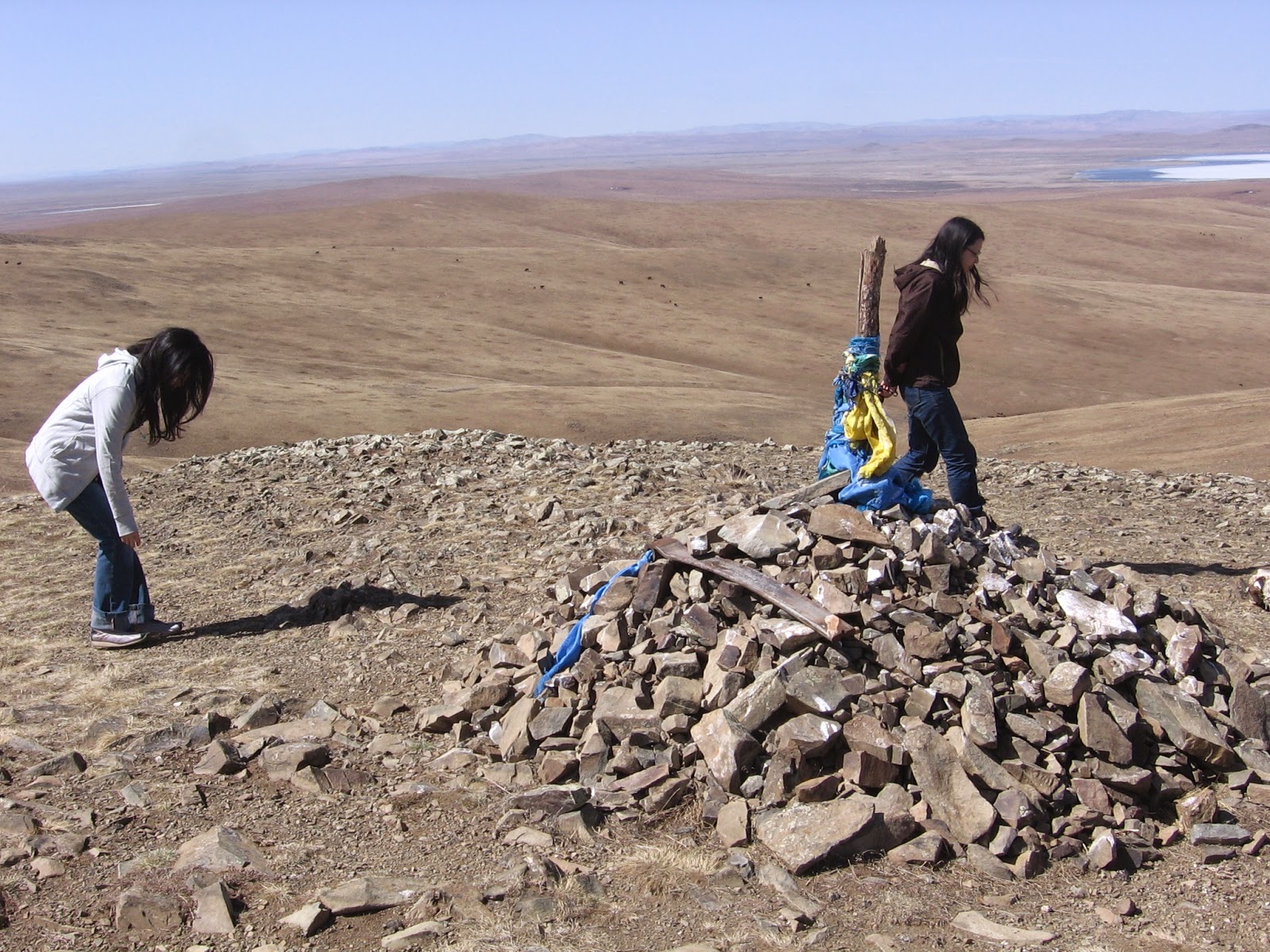
Овоо тойрон явах - Circumambulating the ovoo
On the way we stopped at an ovoo by the lake. Ovoos often mark boundaries, and if you pass one it is customary to attend to them before continuing with your journey. Usually, this requires walking around it clockwise three times and putting three stones on it.

When we got to the lake, it was melting, but the majority of the surface was covered still covered in ice, sometimes all the way to the shore.


It was often thin ice though. I didn't walk carefully enough, and one of my feet plunged through it. I came in my rubber boots, but the water flooded right in and I had to take it off and dry it off. Luckily, Ögii is very shallow, and I would have had to walk further out to get to a place deep enough to drown.

My feet, before they got wet.

The area was largely bare. The village area was farther away, and spring was still waking up. There were some living things around, but sometimes in surprising places. I found a ladybug out on the ice, but when I picked it up, it shook itself off and flew away. I found two live ladybugs just chilling, literally, on the lake.

One of two live ladybugs I found on the lake
Other hardy life forms included weeds, moss, and of course, lots and lots of lichens, which were colored brightly and covered most of one of the promontories.

Lichens
We didn't see the far side of the lake, but it was beautiful enough where we were, and a fine conclusion to the trip.

Ögii Lake

Ögii Lake

Ögii Lake

The other side of Ögii Lake

A small cliff

Sitting on the shore

Another ovoo

Sunday, April 14, 2013

MWW 45: Өвөл

Cyrillic
өвөл

Transcription
övöl
IPA
[ˈөwəɬ]
Layman’s Pronunciation
OH-wool
(or, like oval with a ‘w’ instead of a ‘v’)
Meaning
winter
In Genghis Khan’s time it was ebül.

Like I mentioned in my first post, I’m running late, because winter is now ending, although I began typing this when it was still beginning. But I can’t use spring again, because I did that last year.

Mongolia is famous for its winter. Mongolia is the coldest country that Peace Corps sends volunteers, and the rumor is that volunteers in tropical countries drink “to the poor guys in Mongolia.” Ulaanbaatar and the Kazakh capital Astana compete with each other for the title of the world’s coldest capital. Parts of Siberia, Greenland, and Antarctica get colder, but they don’t have their own capitals. It’s not just latitude that makes things cold. Northen Europe gets the gulf stream. Also bodies of water moderate temperatures while dry land makes them more extreme. Mongolia is in the middle of the biggest solid landmass in the world. Furthermore, it has a comparatively high elevation. After adapting to the air at 5000m, another volunteer explained his experience of returning to sea level as feeling like he was on speed. (Which makes me ponder, “How much wood could a Mongolian woodchuck chuck if the woodchuck could chuck wood in Hawaii?”)

This means that more than half the months of the year - all of winter, and most of spring and autumn - have an average temperature below freezing. The ambient temperature drops below that point in October and doesn’t rise above it until March. Autumn and spring are the big times for snow. Snow rarely falls during winter, because it’s too cold for water to evaporate to form precipitation. Nevertheless, winter is full of snow, because the snow that falls in the autumn may not melt for 3-5 months. Despite predictions to the contrary, this winter was mild. Snow didn’t fall until October and it didn’t become permanent until November 1, and it already began to melt by the end of February. My first year it snowed on September 12 and became permanent by late October and didn’t melt until mid-March - about 3 weeks more on each side. Even that year was considered a good year though. In previous years I’ve heard of permanent snow on September 1. About 3 years ago, I heard, the thermometer read -60 C late one evening in Kharhorin.

Winter has its advantages. It’s cleaner than summer. Diseases that spread easily in warm temperatures disappear once it starts snowing. Flies, and most other insects, disappear completely for half the year. Nothing smells bad. Regular bathing becomes unnecessary (and uncomfortable) because you don’t sweat a drop for days and days. You can keep huge quantities of food frozen for months and months for free without electricity just by leaving it outside in a shed. You can also refrigerate stuff just by leaving it on your floor. All this winter, I never saw mold on anything. I’ve had milk sit in my ger for 2 weeks without spoiling. Alcohol can be safely and easily distilled by leaving it outside to partially freeze. Baking, which would make you swelter during the summer, can be comfortably accomplished in winter in the normal course of heating your home by putting the food on top of your wood stove. You can always add more coats and blankets, whereas when you’re too hot, there’s a limit to how much you can take off, even if you disregard modesty. For travellers, you can lodge in nearly empty guesthouses for lower prices than summer, because almost everybody visits during the summer. There are also the aesthetic pleasures of snow and wood fires.