Friday, November 23, 2012

MWW 34: Төгрөг - Part II

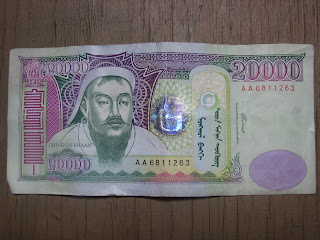
This post is turning out to be pretty long, so I'm splitting it. How about some pictures of төгрөг? Mongolia doesn't use coins, only paper money. The bills come in 11 denominations: 1, 5, 10, 20, 50, 100, 500, 1000, 5000, 10,000, and 20,000 tugrug. Each of the different bills is printed in a different color or set of colors, and with a slightly different size (larger denominations have larger bills). With the exception of the 1-tugrug note (which is almost never used anymore), the small denominations (5-100 tugrug) have a picture of D. Sukhbaatar, and the larger denominations (500-20,000) have a picture of Chinggis (Genghis) Khaan.

1 Төгрөг

The one-tugrug note has a very stylized lion on the front. It is the only note that doesn't have a human image on it.

5 Төгрөг 

10 Төгрөг 


20 Төгрөг 

50 Төгрөг

100 Төгрөг


500 Төгрөг


1000 Төгрөг


5000 Төгрөг


10,000 Төгрөг


20,000 Төгрөг


MWW 34: Төгрөг - Part I

Cyrillic
төгрөг

Transcription
tögrög
IPA
[ˈthөk.rөk]
Layman’s
Pronunciation
TOOK-rook
Translation
1. Mongolian currency
2. circle
In Genghis Khan’s time it was tögürig.


Presumably, the currency took its name from the word for “circle,” rather than the other way around. The Japanese yen (en in modern Japanese, wen in pre-modern Japanese) also comes from the Japanese pronunciation of a Chinese character () referring to a circle, which is yuán in Modern Mandarin Chinese. You wouldn’t guess it from looking at төгрөгүүд (the plural) now, because they certainly aren’t circular. They’re printed on rectangular sheets of paper, just like American dollar bills. But perhaps in the past төгрөгүүд were represented by circular coins.

The exchange rate now, I think, is about 1300 tugrug to 1 US dollar. A tugrug can get you pretty far, most of the time. Here are the prices (with variation) of some items:


Tugrug
USD
30L of water from a well
20
0.02
a 1-minute phone call
70
0.05
1 buuz in a restaurant
300
0.23
1 egg
400
0.31
a city bus ride
400
0.31
an hour in an internet café
500
0.38
1km in a taxi
700
0.54
a loaf of bread
800
0.62
1kg potatoes
800
0.62
1L milk
1000
0.77
1kg rice
1000
0.77
a bottle of Mongolian beer
1200
0.92
1.5L of Pepsi
1400
1.08
a chocolate bar
1500
1.15
a public shower
1500
1.15
a letter to America
1700
1.31
a tub of butter
2000
1.50
a bag of boov
2300
1.80
1kg of apples
4000
3.08
a haircut
4000
3.08
a box of Frosted Flakes
6000
4.62
a dorm bed in a hostel
6000
4.62
1kg of boneless beef
8000
6.15
1 ton of coal in a mining town (rumored)
8000
6.15
a bus ticket from UB to Tsetserleg
23,000
17.70
1 month’s rent in a ger
50,000
38.46
1 goat
80,000
61.54
a ger
700,000+
538.46

As you can see, most things (especially coal) are cheaper than in America, with a few exceptions - a letter sent to America from a rural area costs 1/3 more than the same letter going the other direction. Contrast this with Japan, where, if I recall correctly, a public bath cost about $5 (although it was much nicer bath).

Ганбаатарын дэлгүүрт найман зуун төгрөгөөр нэг килограм төмсийг авч чадна.
Ganbaatar.GEN store.DAT eight.ADJ hundred.ADJ togrog.INS one kilogram potato.ACC take.PART can.NON-PAST.
Ganbaataryn delgüürt naiman zuun tögrögöör neg kilogram tömsiig avch chadna.
In Ganbaatar’s store, for eight hundred tugrug you can buy one kilogram of potatoes.

Keep going for more on tugrugs...

China, Part III: Shanghai, Days 3-5

August 1

August 1 was spent entirely in the Shanghai Museum, which is probably the best museum I've ever visited. Not only was it impressive - with an array of pre-modern artwork that was more than I could take in at one time - but it was free. I showed up at opening and stayed till it closed at 5:00, but didn't manage to see everything. I wore out 5 pairs of batteries taking pictures, and then by 4:30 finally ran out and wasn't able to take any more pictures for the rest of my visit.

Ancient Sculptures


The Thousand-Buddha Stele. I only counted 700 some.

Kasyapa, a forerunner of the historical Buddha Siddhartha Gautama

Lion sculpture bearing a striking resemblance to Iron Maiden's Eddie

Bronzes

Frog on a giant bronze pot


Pottery and Ceramics

There was so much blue-and-white china here, I deliberately took pictures of stuff that was other colors.


Ceramic that looks like bronze

Ceramic that looks like wood


Seals


Calligraphy


Painting


Still life by Giuseppe Castiglione, a Jesuit missionary and court painter in the Qing Dynasty


I'm sorry that I don't have descriptions for all of these. I actually took pictures of most of the nameplates too, but lost a lot of those pictures when I transferring them to a flash drive that I wasn't aware was corrupted.

August 2-3

On August 2, I didn't do so much: went to get money changed, then walked around to buy souvenirs for people back in Mongolia, and finally had dinner again with my friend. On August 3, I didn't do anything: I caught the train in the morning, and was on the train all the rest of the day!

Thursday, November 22, 2012

MWW 33: Зуд

Cyrillic
Зуд

Transcription
zud
IPA
[tsʊd]
Layman’s
Pronunciation
DZOOD
Translation
blight, disaster, harsh winter
In Genghis Khan’s time it was jud.

A зуд, or “harsh winter,” is a Mongolian term which covers a variety of weather disasters, which all have one important common denominator: animals can’t find forage, so they can’t eat, and they die. As such it is a particular and very bad kind of хатуу өвөл (harsh winter). There are a variety of reasons why animals might not be able to get food, and this is the basis for distinguishing different kinds of зуд.

  • Хар Зуд - “Black Zud.” Little rain falls during the summer, so there isn’t much plant growth and not enough food is left for the winter. The animals run out of food, so they can’t eat and they die. Since I’ve also seen this as харын зуд, where the appearance of the genitive ending -ын suggests that we’re dealing with a noun here, maybe it could also be translated ominously as “Zud of Blackness.”
  • Цагаан Зуд - “White Zud.” A bad blizzard. Snow falls buries the land. The snow is so deep animals can’t dig their way to the plants underneath. They can’t eat, and they die.
  • Ган Зуд - “Gan Zud.” During this kind of zud, rain falls and then freezes, trapping grass inside a solid sheet of ice that animals can’t break through, so they can’t eat and they die. A lot of sources call this an “iron zud,” because ган means “steel” or “iron.” However, I don’t see the connection with iron, and there are at least four other homophones of ган[1][2], so I wonder if these people may be translating ган зуд wrong, albeit evocatively.

Aside from that, the phrase зуд турх means “famine.” When any of these disasters happen, you may say:

Зуд
бол-
-сон.
Zud
become
PAST
A zud happened.

Zud can be more generally a term for any disaster, as in this saying:

Сүрэг малын зуд байгалиас
Сүрэг
мал
-ын
зуд
байгаль
-аас
herd
animal
GENITIVE
disaster
nature
ABLATIVE
Animal disasters are from nature
Сурагч хүний зуд залхуугаас
Сурагч
хүн
-ий
зуд
залхуу
г
-аас
student
person
GEN
disaster
lazy
(epenthetic
consonant)
ABL
Student disasters are from laziness

Zuds are a big deal. For a herder who depends entirely on animals, a bad zud can wreck his life. For the entire country, whose major industry is herding a zud can mean economic disaster. When this many animals die, people end up going hungry as well.

People are always wary of a zud happening and will do whatever they can to mitigate it. In my area, early September, about the time frost arrives, brings a frenzy of mowing, as everybody and their mother hoards hay to feed their animals during the winter. A lot of rain fell this summer - an unusually large amount, people say - so we will definitely not have a Black Zud. And it’s already pretty late for rain to fall, so we probably won’t have an Ice Zud.


[1] Altangerel
[2] Mongolian Tour Guides Association

Wednesday, November 21, 2012

MWW 32: Хөрзөн

Cyrillic
хөрзөн

Transcription
hörzön
IPA
[ˈxөrtsəŋ]
Layman’s
Pronunciation
HOOR-dzung
Translation
compressed dried dung
In Genghis Khan’s time it was körjen.

Хөрзөн is kind of like processed аргал. When animals are corralled during the winter, their urine and feces accumulate on the ground in the pen. Through constant trampling this mixture is pounded into a hard substance. This is хөрзөн. In the spring, herders dig the stuff out in large blocks with a shovel (хүрз) and keep it to be burned the next winter. It is said to burn hotter, and longer, than straight-up аргал. However, it also produces an undesirably large amount of ash. And you thought poo had no surprises left, didn’t you?

Хөөрзөн, along with a stockpile of wood


Хөрзөн бол малын хашааны шал.
Хөрзөн
бол
мал
-ын
хашаа
-ны
шал
Compressed dung
TOPIC
animal
GEN
fence/yard
GEN
floor
Hörzön is the floor of a corral.

MWW 31: Намар

Cyrillic
Намар

Transcription
namar
IPA
[ˈnamər]
Layman’s
Pronunciation
NAH-mer
Translation
autumn, fall
In Genghis Khan’s time it was namar.

Намар is one of the four seasons, the one that is happening right now. Autumn here is a lot like winter in some other places. Actually, it's more wintery than California's winter ever is, because it snows here from very early in the autumn season. Fall is my favorite season here, because unlike winter, it's not too cold, unlike summer, it's not too hot, and unlike spring, it's not too windy. Fortunately, this fall has been milder than the last one, but we did have a snowstorm on November 1, followed by a noticeable downturn in temperature. More snow came on Nov. 8, and it's probably here to stay for the winter.

Those of you who read the spring entry will remember that Mongolians have verbs and greetings related to spring. They do for autumn too.

намарших
намар болох
to become autumn
намаржих
to pass the autumn
намаржин
during the autumn
намаржаа
an autumn encampment
намаржаанд буух
намаржаалах
to move to an autumn encampment
Сайхан намаржиж байна уу?
(Сайхан намаржжийн уу?)
How is your autumn?
Are you having a good autumn?
Are you “fall”-ing well?