Monday, March 12, 2012

MWW 13: Бууз


Cyrillic
бууз

Transcription
buuz
IPA
[pʊ:ts]
Layman’s
Pronunciation
BODES
Translation
large steamed meat dumpling
In Genghis Khan’s time it was buuja.


Buuz is one of Mongolia’s chief dishes. To quote a conversation one of my friends had,

Bryce:                          What is buuz?
Mongolian teachers:      It is a Mongolian national food.
Bryce:                          I know, but what is it made of?

To answer that last question, buuz is made of flour, water, meat, and usually onions. The meat is finely chopped and mixed with finely chopped onions, sometimes seasoning, and whatever other optional ingredients you want to add. The dough is rolled into little circles and filled with the meat mixture. Then you pinch the top to seal it. (Mongolian women usually pinch the top in one of several neat, floral-looking patterns. This is notoriously difficult for Peace Corps volunteers to do.) Then you steam it.


The buuz above is pinched along a long seam. You can see some nice pictures of more typical top-pinched buuz here:
Buuz is usually made without yeast, but it can be made with yeast. In this case it is called мантуун бууз (mantuun buuz) after мантуу (mantuu), a kind of Mongolian steamed bread.

Buuz is stereotypically Mongolian, and is eaten throughout the year, but it has a special place in Tsagaan Sar. It can be compared to turkey. Turkey is easy to find in America and scarce in most other places (including Mongolia), and is eaten throughout the year in sandwiches but takes center stage during Thanksgiving. In the case of buuz, my hashaa family made and froze 1,600 buuz in preparation for the holiday.

бууз                 чимхэх
buuz                 chimheh
[pʊ:ts              ’tʃhim.xex]
BODES           CHIM-khekh
to pinch buuz

Бууз                чимхэж          чадах уу?
Buuz                chimhej           chadah            uu?
[pʊ:ts              ’tʃhim.xetʃ        tʃhat.xʊ:]
BODES           CHIM-khej      chat-KHOH?
Can you pinch buuz?

Чадна             шүү!
Chadna           shüü!
[
’tʃha.dǝn         ʃʉ:]
CHAD-uhn      shoe!
Yes I can!

Яамар                        муухай           бууз!    Чадахгүй.
Yaamar            muuhai            buuz!    Chadahgüi.
[ja:mǝr            mʊ:χæ           pʊ:ts.   tʃha.dǝx.kʊ:]
YAH-mer         MOO-kha        bodes!  Chah-dukh-GOO.
What an ugly buuz! You can’t (pinch).

PS: I had been called to the capital by Peace Corps for an emergency drill when I was updating about Tsagaan Sar. Then my ride back showed up while I was working on the blog. So, buuz and hadag didn't get posted, and tsagaan was scheduled to be posted before I finished typing, so I added more to it just now.


Read More

Buuz recipe on All Mongolian Recipeshttp://www.mongolfood.info/en/recipes/buuz.html

Sunday, March 4, 2012

MWW 12: Сар


Cyrillic
сар

Transcription
sar
IPA
[sar]
Layman’s
Pronunciation
SAHR
Translation
month; moon
In Genghis Khan’s time it was sar-a.


There are twelve months in a year, and coincidentally “month” is the twelfth word in my series of Mongolian words.

It’s not uncommon for the words “moon” and “month” to be the same in many languages. In fact, the English words “moon” and “month” are closely related - but you probably guessed from the fact that they share most of the same letters. Japanese spells both with the character , but pronounces it differently when talking about the moon (tsuki) or about a month (gatsu/getsu). But that’s only because it borrowed gatsu/getsu from Chinese. I presume that before that tsuki was used to mean month as well.

Сар appears in the names of all the months:

Нэг сар           January
Хоёр сар        February
Гурван сар    March
Дөрвөн сар    April
Таван сар      May
Зургаан сар   June
Долоон сар    July
Найман сар   August
Есөн сар        September
Арван сар     October
Арван нэгэн сар       November
Арван хоёр сар         December

Incidentally, I just gave you the numbers one through twelve - in their attributive forms, at least. The months also have traditional names using the 12 animals of the zodiac.


Хулгана сар   mouse month
Үхэр сар         cow month
Бар сар           tiger month
Туулай сар     rabbit month
Луу сар          dragon month
Могой сар     snake month
Морь сар       horse month
Хонь сар        sheep month
Бич сар          monkey month
Тахиа сар       chicken month
Нохой сар      snake month
Гахай сар       pig month

Сар is a popular element in names as well - all girls’ names, as far as I know. Here are some examples:

Сарантуяа    “Moonbeam”
Сарангэрэл   “Moonlight”
Саранчимэг  “Moon adornment”

In each of these examples, the -ан- is what is sometimes called the “n-stem” or the “hidden n,” which usually appears in certain oblique cases, or when the noun is used attributively (as in the names above). Some nouns have it, some don’t. You just have to memorize it as you go, because I have yet to see a Mongolian dictionary that tells you which nouns have hidden ns.

More:

бал сар            honeymoon (a literal translation)
нар сар            a pumpkin ("sun moon"?)   


There's also сар шувуу "a buzzard," which I thought meant moon bird, but it turns out a сар with a different etymology means "buzzard" by itself, and the шувуу (literally bird) may have been added to remove the ambiguity.

Цагаан Сар хоёр сарт болдог.
Tsagaan Sar hoyor sart boldog.
[tsha’ga:n sar xɔjǝr sarth pɔɬtǝk]
tsa-GAHNG sahr HOY-er sart BOL-duck.
White month two month.DATIVE become.HABITUAL.
Tsagaan Sar happens in February.

Tsagaan Sar

Tsagaan Sar, the biggest holiday of the Mongolian year, is the Mongolian version of Lunar New Year familiar from other East Asian cultures. As such its date varies from year to year according to the moon. This year it was scheduled for February 22-24. This is later than Chinese New Year, so they must be looking at different moons, I guess. That date is approximate though, as it really starts the night of Feb. 21 and then fades out through March. Like Christmas in America, the "Tsagaan Sar season" actually begins even earlier when you take into account all the preparation that goes into play. Over a week before it began, I helped my hashaa family make 1600 buuz. The primary mode of celebration is by visiting people's houses and gorging oneself in a way that would embarrass Thanksgiving. For example, I visited 26 or 27 households (I've forgotten) and probably ate over 100 buuz over the 6 days beginning on Feb. 21. I was actually a bit overenthusiastic, because I later found out most people only visited a half dozen houses or so, but in my ignorance I ambitiously attempted to visit every teacher. Not that anyone is complaining.

A Tsagaan Sar table arrangement: boov, sheep's back, vodka, juice, fruit,  kimchi (replacing traditional pickled vegetables), potato salad, and buuz
Another setup. Notice on the back wall, the horsehead fiddle and the Chinggis Khaan tapestry. Half the homes I've been to have one of these tapestries.

L-R: a boov pyramid, sheep's back, and bottle of vodka - perhaps the 3 most important items

An urn of airag

An ornamental snuff bottle and purse/wallet

People at a Tsagaan Sar feast

One of the highlights was receiving a new deel from my hashaa family, on which people proceeded to spill tea, airag, and vodka. Another one was when my counterpart took me to visit her inlaws, who are camel ranchers. So, I got to ride a camel named "Lik."

Me, wearing a deel and riding a camel


MWW 11: Цагаан


Cyrillic
цагаан

Transcription
tsagaan
IPA
[tsha.ʀa:ɴ]
Layman’s
Pronunciation
tsa-GAAHNG
Translation
white
In Genghis Khan’s time it was caγan.


This time I present you with a batch of four words. In honor of Цагаан Сар (Tsagaan Sar), Mongolia’s biggest holiday, which started on February 22 and fades out over this month, all four words are related to Tsagaan Sar in some way. The first one is the first word in the name Цагаан Сар: цагаан, which means “white.” Цагаан also appears in some set phrases:


цагаан алт
white gold
platinum
цагаан архи
white alcohol
vodka
цагаан баавгай
white bear
polar bear
цагаан борз
?
mistletoe
цагаан будаа
white grain
rice (cf. хар будаа “black grain,” and шар будаа “yellow grain,” both meaning “millet”)
цагаан бурхан
white god / Buddha
smallpox
цагаан гаа
?
ginger
цагаан газар
white earth / place
plain, steppe
цагаан даавуу
white cotton
pajamas
цагаан идээ
white food
dairy products
Цагаан нуур
white lake
name of several lakes and sums throughout Mongolia
цагаан самбар
white board
whiteboard
цагаан санаа
white thought
benevolence
цагаан сэтгэл
white feeling
benevolence
цагаан толгой
white head / hill
the alphabet
цагаан тугалга

tin (cf. хар тугалга, “lead”)
цагаан хоол
white meal
vegetarian food
цагаан хоолой
white throat
windpipe
Хятадын
цагаан хэрэм
China’s white fortress
The Great Wall of China


As you can see, aside from its literal meaning, it also carries connotations of goodness and purity. There are also some idiomatic phrases, like цагаан толгой and цагаан газар (I can attest that the steppe is not white where I live). Anyone want to speculate on the origin of such phrases? I assume that цагаан бурхан is a euphemism because referring to a plague literally would be taboo. And why does "white" imply "dairy" when attached to "food" but "vegetarian" when attached to "meal"?

The meaning goes much deeper than just the word цагаан though, all the way down to the element ца-. My dictionary reveals a whole bunch of words related to light or purity which begin with ца-.

цаас
paper
цагаадах
to be rehabilitated
цагаатлах
to be absolved
цайвар
light-colored
цайлган
kind-hearted
цайр
zinc
цайрах
to be pale
цайх
to turn pale, to go gray (hair)
цал
hoarfrost
цардуул
starch
цас
snow
цахилган
lightning
цахих
to strike, to flash

Tuesday, January 24, 2012

MWW 10: дүү


Cyrillic
дүү

Transcription
düü
IPA
[tʉ:]
Layman’s
Pronunciation
DOOH
Translation
younger sibling;
younger
In Genghis Khan’s time it was degüü.


By my calculations I owe you three words of the week. Continuing with the theme of words that make distinctions English doesn’t, this day’s (week’s?) word is дүү.

There’s probably no better word to begin talking about the differences between traditional Mongolian and English-speaking families. Дүү does not correspond in a one-way relationship to any English word for a relative, because it can refer to either a younger brother, or a younger sister. Mongolian does not have separate words for them. However, it never refers to an older brother (ах) or an older sister (эгч). Basically, дүү is a word that classifies relatives by their age, not their gender.

Of course Mongolians can be specific if they want. If they want to be more specific they can call a younger brother эрэгтэй дүү or бүстэй дүү and call a younger sister эмэгтэй дүү or бүсгүй дүү. English speakers can also add “younger” or “older” to the words “brother” or “sister” if they want to talk about how old they are. The point is that English speakers have to specify gender when they talk about siblings, but they don’t have to specify age, and that Mongolians have to specify age, but they don’t have to specify gender (at least for younger siblings).

This is part of a bigger pattern. English words for relatives usually indicate the gender of the relative (except “cousin”). They don’t distinguish the ages of people in the same generation. Mongolians words for relatives don’t always distinguish the gender of the relative, but many of them distinguish whether relatives in the same generation are older or younger. For example, in addition to the words for siblings, Mongolian also has different words for one’s aunts and uncles, depending on whether they’re older or younger than one’s mother or father.

Perhaps in Mongolian culture age is just a bigger deal than it is in America. Perhaps it has to do with the fact that older children often participate in the family’s work, including acting as a caretaker for younger children. Children of different ages really aren’t considered the same or equal. I do know that in my сум (county), children of rural nomadic families usually have to live in a dormitory during the school year. Students are grouped in dorm rooms primarily by who is related to whom. For most of the year school children don’t live with their parents, but they do live with their older brothers and sisters, who are then responsible for their дүү нар (that’s the plural of дүү). Of course this doesn’t apply to the hundreds of years before Mongolians had primary-school education. I don’t really know the reason, but I do know there is some deeply ingrained social reason that Mongolians feel that the age of relatives is essential information, but Anglophones don’t.

She’s дүү-er than me


Дүү refers to age in a more general sense because people use it to talk about who’s older or younger, even when they aren’t related to each other. To say that someone is younger than you, you would say something like,

Тэр надаас дөрвөн нас дүү.
She-NOMINATIVE me.ABLATIVE four year younger-sibling
“She is four years younger than me.”

using the word for younger sibling. It could be rendered into English as “She is my younger sister by four years,” but “she” doesn’t have to be related to the speaker at all in order to say this. Here, it simply means, “She is four years younger than me.”

Confusion


If the different way of talking about relatives confuses you, don’t worry, it confuses Mongolians too. Mongolian schoolchildren seem to have been taught that English “brother” is equivalent to Mongolian ах (older brother) and English “sister” is equivalent to Mongolian эгч (older sister). They also know that “younger brother” and “younger sister” both mean дүү. However, it’s never pointed out that Mongolian and Western notions of family are different, or how. Many of them don’t realize that “younger” is a separate word that describes “brother” or “sister” and is completely optional. This means that whenever I talk to Mongolians, they almost always tell me that a younger brother is a “younger brother.” For the rest of the conversation, they will continue to use the full phrase “younger brother,” even though I knew long ago that he was younger.

In fact, many of them don’t realize that a “younger brother” is still a kind of brother and that a “younger sister” is still a kind of sister. This means that (no joke) I have also had conversations like this:

Me:                  Do you have a brother?
Student:            No, I do not have a brother. But I have two younger brothers.
Me:                  ???

I really think these kids need to learn more about culture, not just memorizing vocabulary and grammar rules.

Erecting a Ger - Part IV: Inside the Ger

Inside the ger, they put up curtain-like wall hangings. These sheets are the equivalent of wall paper. They look prettier than the wall framework and gray felt sheets. Like some of the other stuff, they have loops that are tied to the top of the wall beams and hang downward.


Now they attach the rope that runs from the very center of the roof ring, goes through the eastern pillar, hangs down, and and is bunched up above the roof poles. Every ger has one of these, but I don’t know why. I'm convinced it must be symbolic rather than functional. In fact, it's taboo to hand your clothes (or anything else) from this rope.


Now the floor needs more work. When it turns out that the floor boards aren’t completely even, one of the boards is padded up by folding an old instant-noodle bulk box and slipping it on top of the board, underneath the plastic floor cover. Now the floor is even!


Giant rolls of scotch tape seal the cracks / gaps in the plastic sheet, so less air seeps in through the bottom of the ger. (Fun fact: The Mongolian word for tape is скоч, from the word "scotch.")


Later part of the floor will get covered with a proper carpet. But as one of my friends asked, since Mongolians have been living in round gers for thousands of years, why don’t they make round floor coverings or rugs?

This is not round

Now the ger is complete and people can live in it! (Well, actually, they still need to set up at the bed and stove.)

Erecting a Ger - Part III: Dressing the Ger

A layer of canvas is put over the roof poles. Ropes help keep it down.


So do cloth loops.


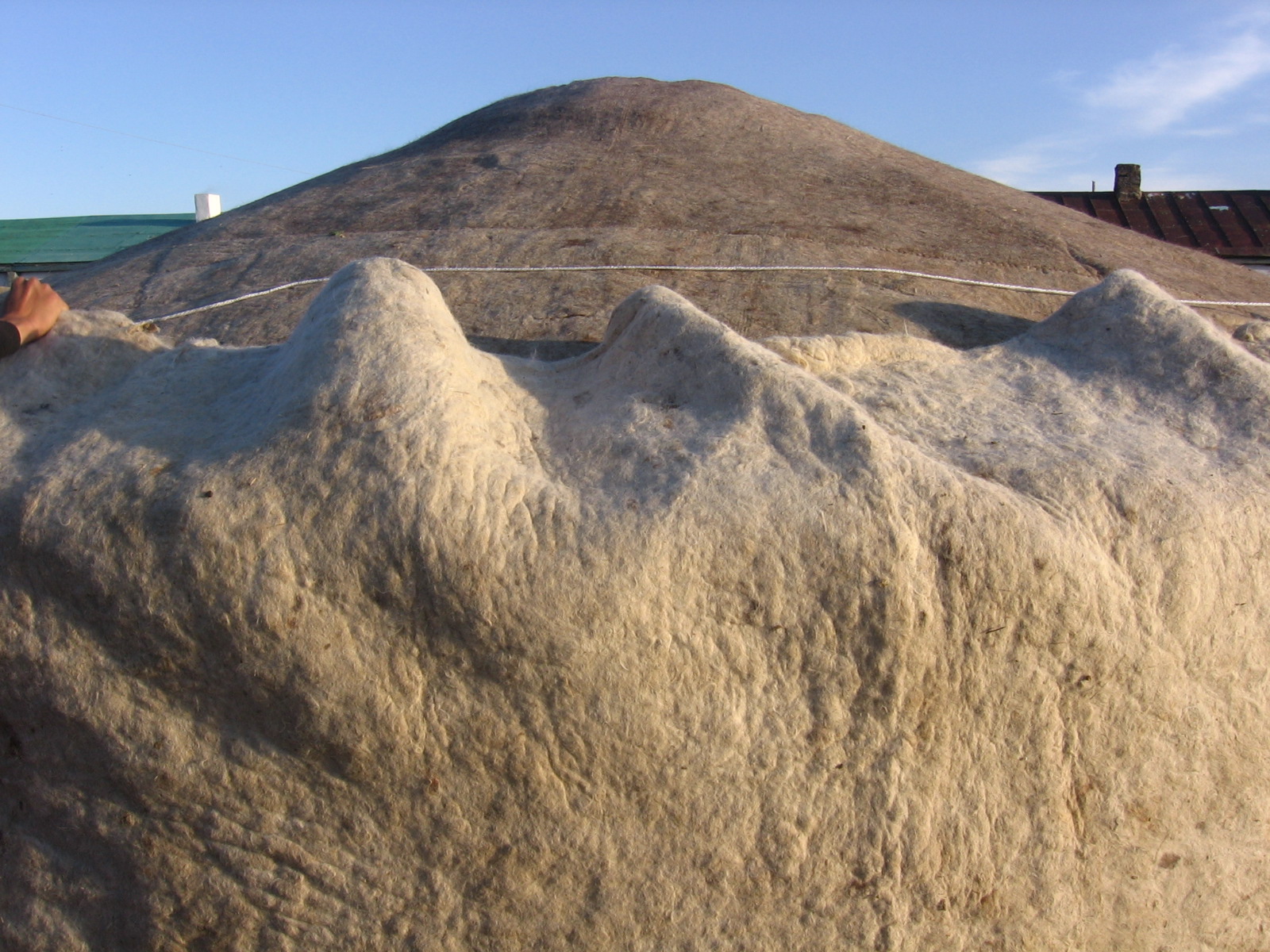
Then there’s a felt sheet over the roof.


Push more of them up with a spare pole.


Felt sheets around the walls. Ropes threaded through one corner of the sheet, over the roof, and threaded again through the other corner, help keep the sheets on the ger.


Putting up the paper covering.


This is Russian. Apparently the paper covering is … milk?


Putting up the waterproof plastic tarp.


More canvas on top.


There are two pillars on either side of the doorframe. Two ropes (or in this case, giant rubber bands, I guess) run all the way around the outside of the ger. They are looped around the poles and then tied to the doorframe.


MWW 9: ингэ


Cyrillic
ингэ

Transcription
inge
IPA
[iŋk]
Layman’s
Pronunciation
INK
Translation
adult female camel
In Genghis Khan’s time it was ingge.


Today’s word is an example of something where Mongolian makes much finer distinctions than English does, and perhaps about how Mongolians care a lot more about camels than Americans do. Today’s word is ингэ, an “adult female camel.” This means that the camel it refers to is fully-grown and female. It is not a male camel. It is not a baby camel. And it most certainly never ever refers to a male llama embryo. By contrast, poor English only has the very broad word “camel,” and to get the level of specificity above it has to tack on two adjectives for a total of six syllables, all to say what Mongolians can say in one concise syllable: ингэ.

Erecting a Ger - Part II: Assembling the Framework

The center of the ger is put together first, upside down. The pillars are lashed to the roof ring.

Roof ring + pillars

Some other people extend the walls and put them up around the floor. You can’t tell, but the tops of the walls lean inwardly slightly. The walls themselves are also a little bent. So the side of a ger isn’t straight but a little convex.

Putting up walls

This is the assembled pillar-and-window set, lying in the middle of the ger and waiting to be put upright.

The beams at the edge of each wall fit together with the edge of the next wall like a puzzle. A rope is woven through the place where they join.

Edges of walls with rope woven through

Then the roof poles are put up. The laced ends rest on top of the walls, and the twine loop is looped over the beams in the walls. The tapered ends are fitted into the notches of the center ring. There’s also a rope running around the top of the ger, through the wall beams, and another one running through the wall beams near the bottom.


Roof poles in place

Twine loop + top of the wall

Roof poles fitting into the roof ring

The ropes running the circumference of the ger are tied to either side of the doorframe. There’s also a rope running from the roof ring to the top of the door frame. Everything is getting all tied together, literally.

Doorframe


Here's another rope in the roof. It must have some function, but I don’t know what.

Another rope