Showing posts with label travel. Show all posts

Monday, May 4, 2015

Ögii Lake

As I mentioned before, Khöshöö Tsaidam was only half of my trip. After that, we visited Ögii Lake (Өгий нуур / Ögii Nuur, also spelled Ogii or Ugii). Ögii Nuur is not only a lake, but also the name of the sum (district) which surrounds it. It lies north of Khashaat sum, and along the same road that connects Kharhorin and Khöshöö Tsaidam. Sometimes people from my town went fishing up here, although according to them, the fish aren't as big as the ones in Tariat.

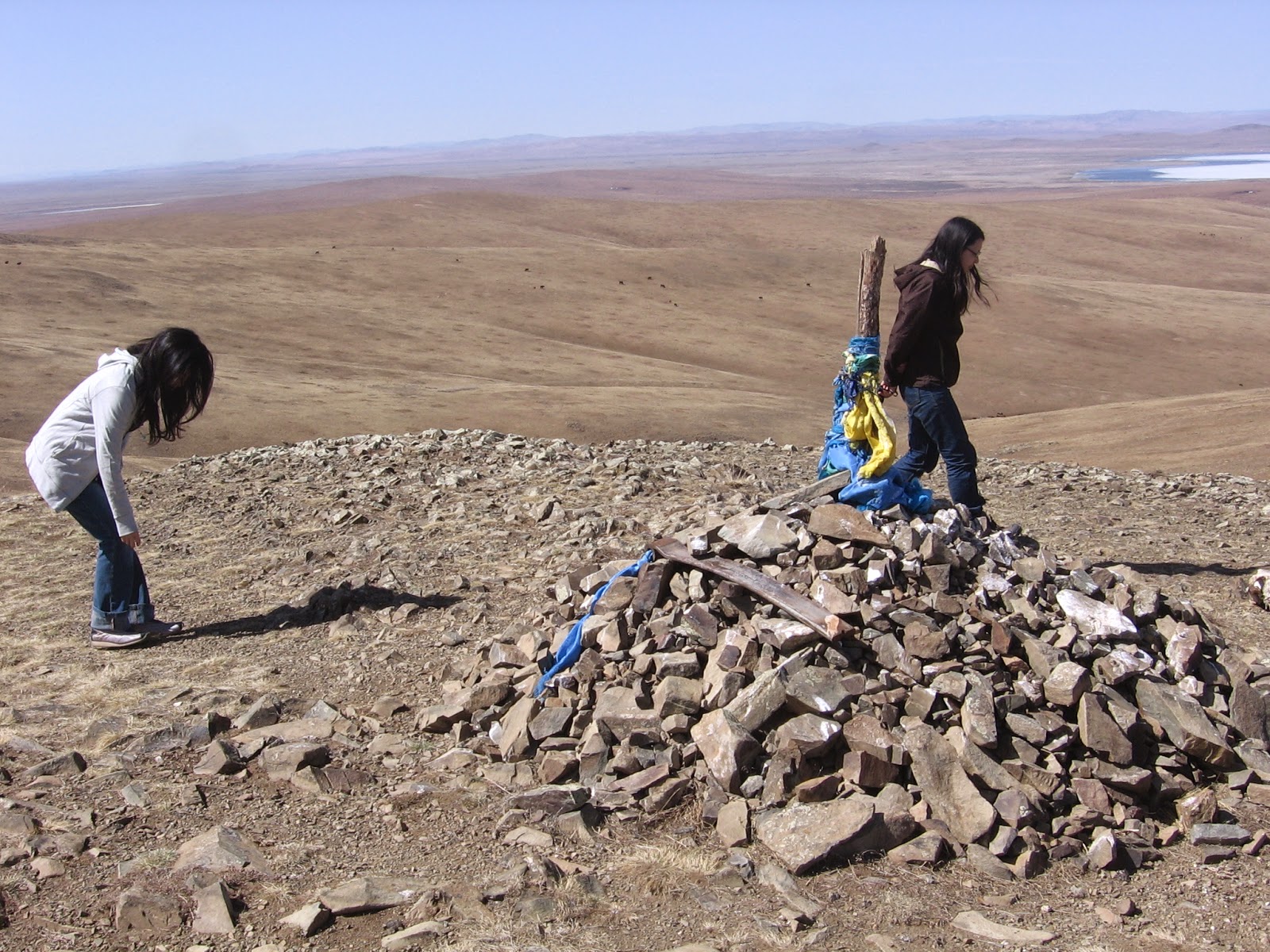
Овоо тойрон явах - Circumambulating the ovoo
On the way we stopped at an ovoo by the lake. Ovoos often mark boundaries, and if you pass one it is customary to attend to them before continuing with your journey. Usually, this requires walking around it clockwise three times and putting three stones on it.

When we got to the lake, it was melting, but the majority of the surface was covered still covered in ice, sometimes all the way to the shore.


It was often thin ice though. I didn't walk carefully enough, and one of my feet plunged through it. I came in my rubber boots, but the water flooded right in and I had to take it off and dry it off. Luckily, Ögii is very shallow, and I would have had to walk further out to get to a place deep enough to drown.

My feet, before they got wet.

The area was largely bare. The village area was farther away, and spring was still waking up. There were some living things around, but sometimes in surprising places. I found a ladybug out on the ice, but when I picked it up, it shook itself off and flew away. I found two live ladybugs just chilling, literally, on the lake.

One of two live ladybugs I found on the lake
Other hardy life forms included weeds, moss, and of course, lots and lots of lichens, which were colored brightly and covered most of one of the promontories.

Lichens
We didn't see the far side of the lake, but it was beautiful enough where we were, and a fine conclusion to the trip.

Ögii Lake

Ögii Lake

Ögii Lake

The other side of Ögii Lake

A small cliff

Sitting on the shore

Another ovoo

Friday, April 17, 2015

Khöshöö Tsaidam / Хөшөө Цайдам

Khashaat's Ruins Evoke Ancient Memories


Exterior of the museum, with Japanese visitors
Khöshöö Tsaidam (Mongolian, Хөшөө Цайдам) - the nearly 1300-yea-old remains of a steppe empire - is the most famous place in Khashaat sum. However, it's far from the village part of Khashaat, hence it requires a special trip. I never ran into it just going about my business. I paid it a visit it last year on April 11, and although I'm a little late (April 17) now, in this blog's current spirit of "This Day in [the] History [of My Time in Mongolia]," let's look at Khöshöö Tsaidam, one of the archaeological treasures of Mongolia.

Poster in my school. It reads, "The Turkic-era memorial complex at Khöshöö Tsaidam, and several artifacts."
Khöshöö Tsaidam is also admired outside Khashaat: This poster is from a series of posters of famous Mongolian places that covered the walls of a classroom in Tsetserleg.

Bilge Khan and the Göktürk Empire


Modern Turkish is the best known of the Turkic languages, but it was spread to the land now called Turkey by invasion from Central Asia. There are many other Turkic languages spoken Central and Northern Asia, and in fact, the Turks may have originated in Western Mongolia near the Altai Mountains. While China was ruled by the Tang Dynasty, most of the lands to its north were part of the Second Turkic Khaganate. This vast nomadic conglomerate was led by the Göktürks or "Blue Turks" (Mongolian: Хөх Түрэг / Höh Türeg), and in the 8th century the Blue Turks were led by Bilge Khagan (Билэг хаан, 683? - 734 A.D.), with the help of his brother and military commander, Kultegin (Көлтэгин / Культегин / Күлтэгин, died 731).

In addition to accomplishing many things politically and militarily, Bilge Khan liked to boast about his accomplishments. To this end, he erected two stele in the valley of the Orkhon river. The stele describe his and his brother's achievements in a bilingual inscription in Orkhon runes and Chinese characters. Those runes (together with a few other inscriptions from the same time) are the oldest writing in any Turkic language.

Билгэ хааны тахилын онгон - "Bilge Khan's sacrificial idol"
How Bilge Khan's monument would have looked in the 8th century

The Turkic Empire soon crumbled, and its monuments were also left to crumble for hundreds of years. The site of these ruins became known in the Mongolian language as Хөшөө Цайдам (variously transliterated as Khöshöö Tsaidam, Khushuu Tsaidam, or Koshu Tsaidam). In the 19th century they were found by Russian explorers, and translated by the Danish linguist Vilhelm Thomsen. Along with other remains of ancient kingdoms scattered along the Orkhon river, Khöshöö Tsaidam was inscribed in UNESCO's world heritage list in 2004 as part of the "Orkhon Valley Cultural Landscape" (Орхон хөндийн соёлын дурсгал) [1]. The museum was established in 2011 - just weeks after I arrived in Mongolia (although I didn't know it yet!) [2]

Headless stone men?

Bilge Khan's crown

The Museum


April 11, 2014 fell during the Mongolian secondary school's spring break, and I was at site, with nothing to do. When my JICA friends from Kharhorin told me they were going to visit Khöshöö Tsaidam and Ögii Lake and asked if I wanted to come, off I went.

When I was invited to Mongolia by Peace Corps and read about archaeological finds in Mongolia, I orignally imagined some broad lonely field with decayed stone brushed by the wind. I wondered whether I should bring tracing paper to make my own rubbings, as past archaeologists have done. I soon realized I had a fat chance of actually touching them - the ruins are in a museum now, of course.

Хар бэхээр зурсан зураг бүхий дээврийн ваар - black ink-drawing on a roof tile

The museum features many small artifacts from that time period, but the centerpiece, of course, is the inscribed steles. Orkhon writing is often referred to as "runes" due to its resemblance to the runes used by the Germanic peoples (and Tolkien's dwarves!), but they arose independently of each other. The sharp, narrow character of Orkhon runes is due to their use in decorating steles like Bilge Khan's. Cutting stone is hard and it's much easier to make straight lines. Around the world, stone-carved scripts tend to be angular and brush-written scripts tend to be curvier. That is not as interesting though, as the fact that apparently Orkhon were sometimes read from the bottom up [3].


One of Bilge Khan's monuments

Having seen them in person, I realize Khöshöö Tsaidam had been interesting to me long before I even knew what it was. When I was a child and beginning to be interested in language, I read an old, fat book about the history of writing around the world. Although I did not remember the name "Khöshöö Tsaidam," I remembered "Orkhon Turkish runes" and a page with a facsimile of them. How strange to think that now I was living next to something I had remembered from a book years ago.

Narrow, angular "runes" on the face of the stela

I took photos of the entire surface of the stele shown above in case I ever had the chance, and knowledge, to interpret it, but it turned out I didn't need to. Passing a tiny merchandise stand on our way out, I saw the book shown below, Хөх Түрүгийн Бичиг by Д. Баатар. The book featured a complete transcription, transliteration, and translation (into Mongolian) of the steles. This being a museum gift shop, it cost almost $30 ... but the book was right there right then and I didn't know if I would ever see it again, so ... of course I bought it!


Read more on this blog about the word хөшөө in the next Mongolian Word of the Week!

More Reading


Notes

  1. See UNESCO's site for the Orkhon Valley Cultural Landscape at http://whc.unesco.org/en/list/1081.
  2. June 27th, 2011, according to the news article "Хөшөө цайдам музейн нээлт боллоо" at http://www.mecs.gov.mn/mod/print/index.php?id=635 (in Mongolian).
  3. This odd writing direction (unique as far as I know of the world's languages) is mentioned on the Omniglot page (http://www.omniglot.com/writing/orkhon.htm). However, from reading my book on the inscriptions - Хөх Түрүгийн Бичиг (The Göktürk Script) by D. Baatar, it seems clear that Bilge Khan's inscription at least does not work this way.
Monday, November 26, 2012

China, Part V: The Trip Back

...but I never got to do them.

The morning of my third day in Beijing, I was alerted to a small problem by the desk of my hostel: my visa was due to expire earlier than the period of time I had booked for that hostel. Oh, really, how did that happen? Well...

I had always planned to take the train into China, since it's cheaper than flying, and at least to me, more interesting. However, train tickets aren't sold in advance, so they're nearly useless for acquiring a visa, because the Chinese visa process requires all the details of your trip in advance. However, the visa doesn't require that you follow those plans, or prohibit you from changing plans, once the visa has been acquired. So taking some other people's advice, I got a plane ticket for the purpose of submitting a complete visa application, then cancelled it and bought a train ticket before I left for China. This is where the problems started.

I was issued a visa for a term of 10 days, based on the tentative itinerary I submitted. That was in fact an accurate estimation of the time I was actually going to stay IN Shanghai and Beijing, walking around and doing touristy stuff. But that's not what counted. Trains and buses move much slower than planes, and when I substituted them for planes, my total transportation time expanded from less than a day to five days (two of them inside Mongolia). Of course, your duration of stay actually starts counting from the time you reach the border, not when you arrive at your destination, and stops when you go back over the border, not when you  get on the bus from your destination. I had failed to factor in the time difference when I made my original plans. So I arrived in Shanghai fully intending to enjoy 10 days of tourism there and in the capital, when in fact getting there had already eaten up 2 of those days.

So, what do I do? I was directed to the police bureau to get my visa extended. The lady I spoke to explained that I could get my visa extended - for the same price as a new visa ($170). She justified this price as the price that the US charges for PRC citizens to get visas. I couldn't get it extended for just three days either. Surprisingly, given that they had individually tailored my original visa time limit to the exact number of days I was expecting to spend sightseeing in China, my visa could only be extended by standard blocks, of 10 days or 30 days. This was because there was a minimum processing time of 7 days. And oh, by the way, the PRC would have to hold my passport during that processing time. That means I couldn't leave the country; in fact, by Chinese law, I couldn't even board the train, or change my lodging, without my passport. I would be held captive in Beijing for 7 days. Considering the visa charge together with my projected lodging and food costs for those days, and assuming I didn't buy any souvenirs or join any tours, I calculated I would be left with $26 USD at the end of my trip.

Or I could leave. I chose that option. And in order to be sure I made it to the border in enough time, I had to leave that day.

I hurried to Beijing Station to try to figure out how to get the bus back to Ereenhot, but NOBODY, not the people selling tickets, knew where the bus station was (because they only dealt with the train, sorry). I was lucky that I attracted the attention of a middle-aged lady who knew some English, and then she asked around and found an old lady who knew the bus to Ereenhot. She offered to take me right there for $20 bucks, but I declined and ran with her information back to the hostel, where they told me where to catch the city bus that connected to the long-distance bus. They were even nice enough not to charge me anything for the extra nights I cancelled. And within 4 hours of realizing I was doomed, I was on my way out of the country.

No Temple of Heaven, no Summer Palace, no Great Wall, no opera, no lakes, no pandas. And I had already been thinking about how I would go back and brag about having taken a complete tour for less than $1000 - which would have been possible, except for stupidly overlooking one detail that nearly made me a fugitive from the Chinese law.

I did receive a consolation prize. My tour bus passed by the Great Wall for about 1/2 hour, and I was able to take pictures from the window.

The Great Wall, as seen from a bus
Like the bus from Ereenhot to Beijing, the travel time was overestimated, and I arrived in Ereenhot in the wee hours of the morning. There were no cars across the border (I didn't even know where the cars picked people up) but a Mongolian family found me a hotel room and got me a car the next morning.

This car broke down at the last checkpoint, so again I had to catch another one to make it all the way to Zamyn Uud. The train station was out of tickets for that day, so I was stuck in Zamyn Uud for at least another day. There is a hotel affiliated with the train station, and fortunately not only did it have rooms but it could also arrange return train tickets for me. Unfortunately, they had no single rooms and I had to share a room with a traveling Mongolian businessman. He fell asleep, snoring, watching dubbed movies in our room, which ended and turned into grainy Mongolian porn. What bothered me more was that he wanted to sleep with the room's door open, because it was too hot (it's true, it was very hot and muggy, but c'mon), so I argued about that and left the movie issue alone.

This time I got a sleeper seat, so the next afternoon I could zone out in comfort the rest of the way back to UB. Once I was back safe, I wasn't upset anymore about having my trip cut short, because it made for a rather amusing story. And thus ends my trip to China.

Sunday, November 25, 2012

China, Part IV: Beijing

On August 3 I went to Beijing. The train rode overnight, for almost a complete day. On the way I met a couple of Chinese university students. One of them was a girl who was studying in Kansas and played on a baseball team. The other one was a guy who said he was going up to Beijing to break up with his girlfriend. Both of them spoke decent English and talked to me for a long time, and helped me out a little about what to do when I got to Beijing.

The first day in Beijing, there wasn't much time, so I stayed around the hostel, and looked up things about China and planned my next moves. Some of the other people in the room invited me out to eat that night. At the restaurant we also met a girl who had visited North Korea.

Beijing Railway Station

Tiananmen Square

The second day was dedicated to the center of the city. Tiananmen Square, the main public space in Beijing, sits right in front of the old imperial palace, the Forbidden City (also known as the Palace Museum). As a matter of fact, the Forbidden City is only accessible through Tiananmen Square. The place is full of people, including people trying to sell you stuff at inflated prices, with some attractions here and there.

Building across the street and south of Tiananmen Square
Approaching the Square

Entering the Square


Chinese workers

Chinese workers

Mao Zedong's Mausoleum
Perhaps because Communists are materialists, they seem to have an almost Egyptian obsession with preserving the physical remains of their leaders. Chairman Mao's body is enshrined here, where the public is free to gaze at him. But only for a couple of hours in the morning. Then it's closed. I got there just too late, and never got to see the corpse.

The Forbidden City

Tiananmen Square was huge, making the approach to the Forbidden City very drawn out and confusing. Every time I passed through a gate or wall I'd think I was about to enter the Forbidden City, only to find myself in another square, empty except for other people, and realize I had to walk all the way to another wall, where, hopefully, it would be the Forbidden City. Of course, I did eventually get there, and when I did I knew it. It confirms the old wisdom, "You're not really there until there's a ticket counter with a line of people."

Approaching the Forbidden City

The Forbidden City's Nameplate


Eaves of the Forbidden City


Quadrilingual inscription in Tibetan, Mongolian, Manchurian, and Chinese
Grass on an imperial roof
The Emperor's Garden
Exit of the Forbidden City
Moat of the Forbidden City

Jingshan Park

When I left the Forbidden City, I felt it was still too early to call it a day, but I wasn't sure what I should see next. There was a sign with a list of other sites of interest, including their directions and distances from the Forbidden City. Most of them were fairly far away, or large, or something else. One of them, though, was Jingshan Park (景山). I'd never heard of it before, but it was directly behind the Forbidden City across the street, far closer than any of the other sites, so I decided to go there. It was fortuitous, because the place turned out to be very interesting, and borderline surreal.

Following a winding path, I made a large semicircle around to the back, and encountered many large dinosaur sculptures.


Raptors rush in for the kill, as children and old people stroll by
The park was alive with many active and sometimes eccentric characters, alone or in groups, playing instruments, singing, dancing, or practicing martial arts (perhaps).


Dancing Couple, and some random gawking tourists
Singers
After I followed my ears to choir above, I noticed I was at the foot of a large hill with a pagoda-like structure at the top, so I climbed it.

View from below
Up there were some people selling various items. I bought some fans for my Mongolian friends. I admired, but did not buy, the canvas purses and wallets shown below.


Peace Corps volunteers can relate
Ironically, this was the only perfectly acceptable English sentence
Once ascended, the hilltop pavilion turned out to possess an incredible panoramic view of Beijing, due to its height, and its location at the geographical center of the city.
Looking back at the Forbidden City from above

The Forbidden City


Self-explanatory

Beijing, to the East


To the northeast, the imperial lakes
The pavilion itself


One group of businesswomen had sets of traditional costumes, and for a few bucks, I got my picture taken on a throne, posing as an emperor of the Manchu Qing Dynasty.

Andrew Huangdi
By the time I left, it was getting dark. On the way back, I saw this radiant white blobular globe, which I believe is a theatre. It was a long walk back to the hostel.


I fell asleep easily and made ready for the next few days of temples, palaces, pandas, and assorted ancient Chinese cultural experiences...