Showing posts with label places. Show all posts

Monday, May 4, 2015

Ögii Lake

As I mentioned before, Khöshöö Tsaidam was only half of my trip. After that, we visited Ögii Lake (Өгий нуур / Ögii Nuur, also spelled Ogii or Ugii). Ögii Nuur is not only a lake, but also the name of the sum (district) which surrounds it. It lies north of Khashaat sum, and along the same road that connects Kharhorin and Khöshöö Tsaidam. Sometimes people from my town went fishing up here, although according to them, the fish aren't as big as the ones in Tariat.

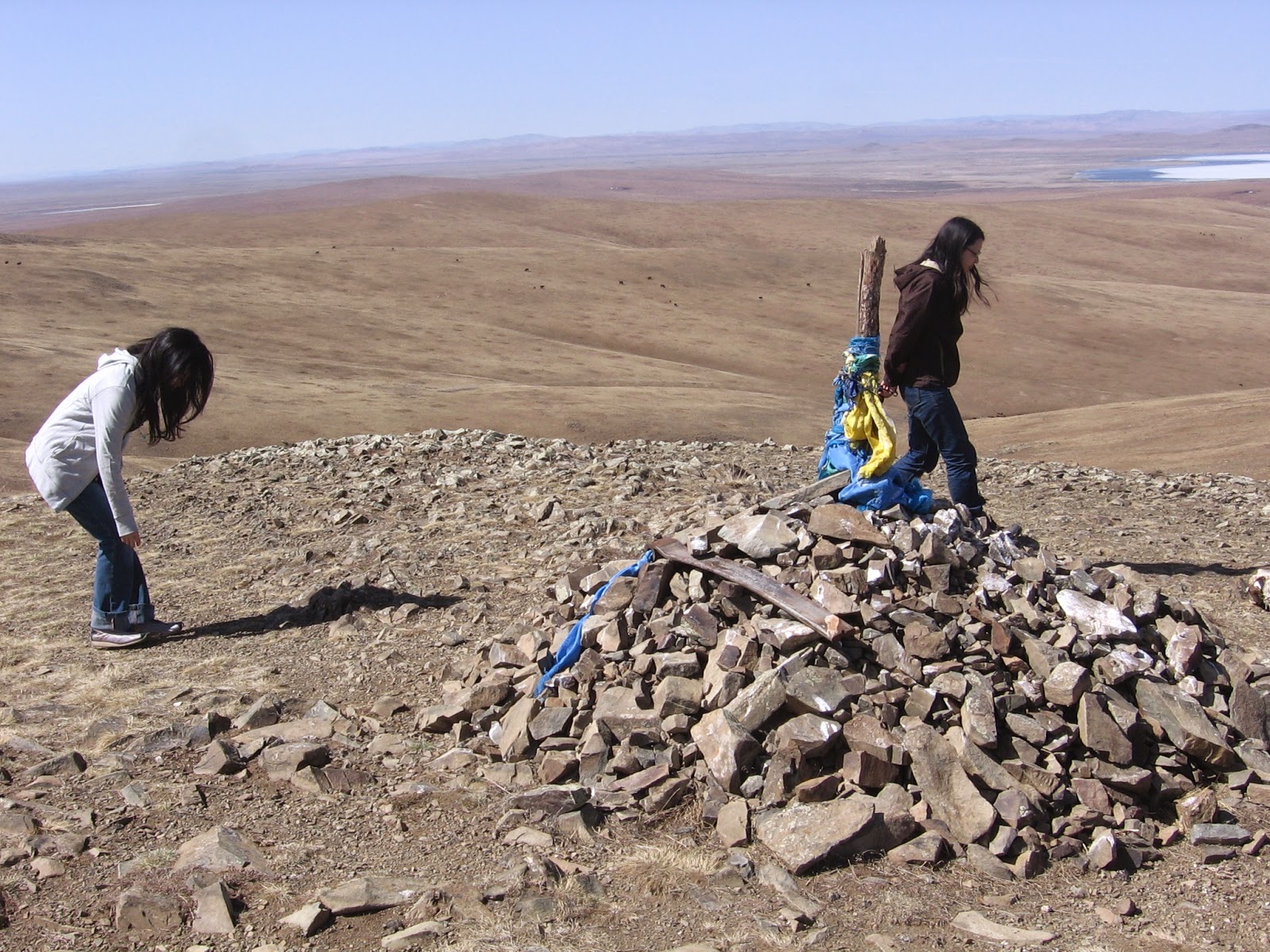
Овоо тойрон явах - Circumambulating the ovoo
On the way we stopped at an ovoo by the lake. Ovoos often mark boundaries, and if you pass one it is customary to attend to them before continuing with your journey. Usually, this requires walking around it clockwise three times and putting three stones on it.

When we got to the lake, it was melting, but the majority of the surface was covered still covered in ice, sometimes all the way to the shore.


It was often thin ice though. I didn't walk carefully enough, and one of my feet plunged through it. I came in my rubber boots, but the water flooded right in and I had to take it off and dry it off. Luckily, Ögii is very shallow, and I would have had to walk further out to get to a place deep enough to drown.

My feet, before they got wet.

The area was largely bare. The village area was farther away, and spring was still waking up. There were some living things around, but sometimes in surprising places. I found a ladybug out on the ice, but when I picked it up, it shook itself off and flew away. I found two live ladybugs just chilling, literally, on the lake.

One of two live ladybugs I found on the lake
Other hardy life forms included weeds, moss, and of course, lots and lots of lichens, which were colored brightly and covered most of one of the promontories.

Lichens
We didn't see the far side of the lake, but it was beautiful enough where we were, and a fine conclusion to the trip.

Ögii Lake

Ögii Lake

Ögii Lake

The other side of Ögii Lake

A small cliff

Sitting on the shore

Another ovoo

Friday, April 17, 2015

Khöshöö Tsaidam / Хөшөө Цайдам

Khashaat's Ruins Evoke Ancient Memories


Exterior of the museum, with Japanese visitors
Khöshöö Tsaidam (Mongolian, Хөшөө Цайдам) - the nearly 1300-yea-old remains of a steppe empire - is the most famous place in Khashaat sum. However, it's far from the village part of Khashaat, hence it requires a special trip. I never ran into it just going about my business. I paid it a visit it last year on April 11, and although I'm a little late (April 17) now, in this blog's current spirit of "This Day in [the] History [of My Time in Mongolia]," let's look at Khöshöö Tsaidam, one of the archaeological treasures of Mongolia.

Poster in my school. It reads, "The Turkic-era memorial complex at Khöshöö Tsaidam, and several artifacts."
Khöshöö Tsaidam is also admired outside Khashaat: This poster is from a series of posters of famous Mongolian places that covered the walls of a classroom in Tsetserleg.

Bilge Khan and the Göktürk Empire


Modern Turkish is the best known of the Turkic languages, but it was spread to the land now called Turkey by invasion from Central Asia. There are many other Turkic languages spoken Central and Northern Asia, and in fact, the Turks may have originated in Western Mongolia near the Altai Mountains. While China was ruled by the Tang Dynasty, most of the lands to its north were part of the Second Turkic Khaganate. This vast nomadic conglomerate was led by the Göktürks or "Blue Turks" (Mongolian: Хөх Түрэг / Höh Türeg), and in the 8th century the Blue Turks were led by Bilge Khagan (Билэг хаан, 683? - 734 A.D.), with the help of his brother and military commander, Kultegin (Көлтэгин / Культегин / Күлтэгин, died 731).

In addition to accomplishing many things politically and militarily, Bilge Khan liked to boast about his accomplishments. To this end, he erected two stele in the valley of the Orkhon river. The stele describe his and his brother's achievements in a bilingual inscription in Orkhon runes and Chinese characters. Those runes (together with a few other inscriptions from the same time) are the oldest writing in any Turkic language.

Билгэ хааны тахилын онгон - "Bilge Khan's sacrificial idol"
How Bilge Khan's monument would have looked in the 8th century

The Turkic Empire soon crumbled, and its monuments were also left to crumble for hundreds of years. The site of these ruins became known in the Mongolian language as Хөшөө Цайдам (variously transliterated as Khöshöö Tsaidam, Khushuu Tsaidam, or Koshu Tsaidam). In the 19th century they were found by Russian explorers, and translated by the Danish linguist Vilhelm Thomsen. Along with other remains of ancient kingdoms scattered along the Orkhon river, Khöshöö Tsaidam was inscribed in UNESCO's world heritage list in 2004 as part of the "Orkhon Valley Cultural Landscape" (Орхон хөндийн соёлын дурсгал) [1]. The museum was established in 2011 - just weeks after I arrived in Mongolia (although I didn't know it yet!) [2]

Headless stone men?

Bilge Khan's crown

The Museum


April 11, 2014 fell during the Mongolian secondary school's spring break, and I was at site, with nothing to do. When my JICA friends from Kharhorin told me they were going to visit Khöshöö Tsaidam and Ögii Lake and asked if I wanted to come, off I went.

When I was invited to Mongolia by Peace Corps and read about archaeological finds in Mongolia, I orignally imagined some broad lonely field with decayed stone brushed by the wind. I wondered whether I should bring tracing paper to make my own rubbings, as past archaeologists have done. I soon realized I had a fat chance of actually touching them - the ruins are in a museum now, of course.

Хар бэхээр зурсан зураг бүхий дээврийн ваар - black ink-drawing on a roof tile

The museum features many small artifacts from that time period, but the centerpiece, of course, is the inscribed steles. Orkhon writing is often referred to as "runes" due to its resemblance to the runes used by the Germanic peoples (and Tolkien's dwarves!), but they arose independently of each other. The sharp, narrow character of Orkhon runes is due to their use in decorating steles like Bilge Khan's. Cutting stone is hard and it's much easier to make straight lines. Around the world, stone-carved scripts tend to be angular and brush-written scripts tend to be curvier. That is not as interesting though, as the fact that apparently Orkhon were sometimes read from the bottom up [3].


One of Bilge Khan's monuments

Having seen them in person, I realize Khöshöö Tsaidam had been interesting to me long before I even knew what it was. When I was a child and beginning to be interested in language, I read an old, fat book about the history of writing around the world. Although I did not remember the name "Khöshöö Tsaidam," I remembered "Orkhon Turkish runes" and a page with a facsimile of them. How strange to think that now I was living next to something I had remembered from a book years ago.

Narrow, angular "runes" on the face of the stela

I took photos of the entire surface of the stele shown above in case I ever had the chance, and knowledge, to interpret it, but it turned out I didn't need to. Passing a tiny merchandise stand on our way out, I saw the book shown below, Хөх Түрүгийн Бичиг by Д. Баатар. The book featured a complete transcription, transliteration, and translation (into Mongolian) of the steles. This being a museum gift shop, it cost almost $30 ... but the book was right there right then and I didn't know if I would ever see it again, so ... of course I bought it!


Read more on this blog about the word хөшөө in the next Mongolian Word of the Week!

More Reading


Notes

  1. See UNESCO's site for the Orkhon Valley Cultural Landscape at http://whc.unesco.org/en/list/1081.
  2. June 27th, 2011, according to the news article "Хөшөө цайдам музейн нээлт боллоо" at http://www.mecs.gov.mn/mod/print/index.php?id=635 (in Mongolian).
  3. This odd writing direction (unique as far as I know of the world's languages) is mentioned on the Omniglot page (http://www.omniglot.com/writing/orkhon.htm). However, from reading my book on the inscriptions - Хөх Түрүгийн Бичиг (The Göktürk Script) by D. Baatar, it seems clear that Bilge Khan's inscription at least does not work this way.

Saturday, December 17, 2011

In the Temple of the Nose

In the interest of reporting events that are long overdue, in late September I went to Хамарын Хийд (Hamariin Hiid) with the teachers from my school. Hamariid Hiid, which means "The Temple of the Nose," is a religious complex located in the sands of Дорноговь аймаг (Dornogovi aimag), which means "Eastern Gobi (desert) province." Apparently it's a tradition of our school to visit this place. When the subject was broached to me, I was initially hesitant because I needed Peace Corps approval to travel, and I was sick. But the teachers convinced me that everyone else was going, and I would be alone in my village for several days, and starve to death. And then Peace Corps approved the trip because it was "work-related," so I went.

To get there we had to drive to the capital, Ulaanbaatar, then take a 10-hour train ride southeast into the Gobi Desert. Almost all of the traveling occurred at night, which meant that I was poorly rested the whole time. From the train station we hired some vans out to a ger camp. I only slept for a couple of hours before we were awoken and driven to a hilltop where we watched the sun rise.

Hamariin Hiid sunrise

Another part of the temple viewed from a distance from the hilltop

Once the sun rose, the pilgrims began walking around two stone mounds on the hilltop, splashing milk on them.


Then we got into the vans and left. For a second I was deeply disappointed, believing that this was the entire site, and that I had paid all that travel fare and lost all that sleep simply in order to watch the sun rise from a different hill. But we disembarked not at the ger camp, but by a large bronze bell. This bell has many inscriptions on it, in Cyrillic...


...in traditional Mongolian script...


...in non-linguistic imagery...


...and in Tibetan. Because Mongolians follow Lamaist Buddhism, which was imported from Tibet, almost all religious literature is in Tibetan. Tibetan inscriptions are found all over icons and temples, and monastic education - which was the only form of higher education prior to the 20th century - was conducted in Tibetan. I've barely learned Mongolian, and now I want to be able to read the Tibetan inscriptions too!


The First Temple

After the bell we went to an open-air temple further away. It consisted of a large open square framed by some sort of small minaret (ubiquitous on Mongolian temples), with a mysterious-looking building in front, an ovoo in the back, and two large gravel circles in the center.

Approaching the temple


A minaret-like thing that I see at every temple


The temple in front, looking vaguely Masonic or something

I began to question why the most salient feature of a temple named "The Temple of the Nose" was an image of a face with no nose. If I understand the explanation, it may be named not after a literal nose, but after the middle level of a mountain, which is also called a nose, and upon which some of this complex is located.

After this, my camera ran out of batteries and all the remaining pictures are on my phone. So there aren't any more pictures in this post.

In the center of the open space are two large circles made of gravel. After taking the guided tour and performing ritual gestures, and praying at the ovoo, everybody lay down on the gravel to absorb "energy" (энерги). Due to the use of a recent Russian loanword instead of, say a native or Tibetan word, I'm wondering if the "energy absorption" is a modern notion. Then we went back to the ovoo, where people sang a song.

The Caves

Nearby are some small cliffs into which caves have been carved by generations of hermit monks. They exist now as objects of veneration by the Buddhist faithful, who crawl into the small rocky holes to bow and and make offerings. 100 or 200 төгрөг / tögrög ($0.07-0.15) is a standard amount. Atop one of the cliffs is another ovoo, and behind that is a slope back down into another ravine. This passes under a natural stone arch. We all walked down the slope through the arch in a long line holding hands. When you pass through the arch you are supposed to become a new person. At the bottom you're supposed to rub your exposed skin (like, on your back) against the rock surface to absorb energy from it. At that point one of the school cooks saw a snake in a bush, and everybody gathered to watch it. Some of them tried to get it to slither in our direction while the original woman knelt, chanted, and moved her outstretched palms in a circular motion that looked like praying. I was told snakes are good luck and Mongolians love them.

Petrified Trees

Then there was a spot further off where some petrified logs lie on the ground.

The Theatre

In another empty spot was a stone commemorating the establishment of the first theatre company in Mongolia.

The Other Big Temple

There was one more large temple (separate from the first one). This one featured a long walkway up to a walled, roofed, enclosed temple. All of the walls inside were decorated with very intricate bas-reliefs of Buddhist deities. Just as in Japan, the entrance had prayer wheels that you spin as you go in.

The Wishing Mountain

Our final stop was a mountain halfway back to the aimag center. Known as the "Wishing Mountain" (no, I don't remember the Mongolian word, it was explained to me in English), this protuberance of the earth's crust is famous for appeasing the desires of men. Men is the key word, because women are not allowed all the way up the mountain. Men can climb the mountain and when they reach the ovoo at the top, after observing the necessary ceremony, think of a wish and shout off the top of the mountain. So the men in our group, leaving the women (who comprised over 2/3 of our party) behind, followed tradition up the mountain. And proceeded to drink vodka. Even though I only sipped, the sheer number of people offering me vodka was enough to make me tipsy. And being tipsy on the top off the mountain is not good. Fortunately I didn't roll off and die. I did get a fantastic aerial view of the Gobi, which you can't see, because my camera had no batteries.

Conclusion

After that we took the train back to UB and a car back to site.