Saturday, April 7, 2012

MWW 19: Үгүй


Cyrillic
үгүй

Transcription
ügüi
IPA
[ʉɣwi]
[ʉɣʉ:]
[kw::::]?
Layman’s
Pronunciation
oo-GWEE
oo-GOO
KKKKK
Translation
no; not; without
In Genghis Khan’s time it was ügei.

Since I already mentioned it in the post about тийм, let’s talk about үгүй. Үгүй is very interesting because in classical Mongolian, it appears to have a been a verb meaning “to have not” or “there is not.” Over the course of the next 800 years it has largely disappeared in that function but at the same time has evolved into a verb suffix, an interjection, a noun, a case ending, and a derivational suffix for adjectives.

The verb suffix

As a verb, үгүй took nouns as its arguments, not other verbs. So how did it get attached to other verbs? There’s a loophole here: verbal nouns. At some point, Mongolians began using gerunds a lot with this verb, eventually crowding out the old negative constructions, which apparently involved a preverbal particle үл. Үгүй’s invasion was highly successful, because now it’s the normal way of forming a negative statement. I’ve never heard anyone speaking normally say үл. In time, it was shortened simply to -гүй and joined to the preceding word.

One of the verbs that did this was the verb “to be / to have,” байх. Even though үгүй by itself had already been a negative existential verb, it contracted with байх to produce the new negative existential form байхгүй, “there is not, have not.” I usually hear this, instead of үгүй by itself.

The case suffix

Үгүй became a case suffix in pretty much the same way it became a verb suffix. It contracted with the noun in front of it as -гүй. In this way it acquired the meaning “without (NOUN),” and became a privative case suffix. It complements the comitative case, -тай, “with.” (The privative case is not usually mentioned in books about Mongolian, but believe me, it’s every bit like -тай, which everyone considers a grammatical case.)

Eventually a sentence like

Хонь үгүй.
sheep be-not
“There are no sheep.”

turned into

Хоньгүй байна. (alternating with Хонь байхгүй!)
sheep.without be
“It is without sheep.”

Notice that now байна has appeared. This is the non-past form of the verb “to be.” Mongolian usually omits the verb “to be,” allowing its meaning to be inferred from context. Presumably it worked the other way here. Once -гүй became reinterpreted as a case-suffix, Mongolians began to feel that there was a missing predicate and inserted “to be” where it never used to be.

The noun

As a noun it means “absence.”

Миний үгүйд олон хүн манайд очсон.
Many people came to my home in my absence.

The derivational suffix

From a case suffix -гүй has nearly become a derivational suffix. Here it is following the lead of the comitative case -тай. There are countless words ending in these suffixes which normally function as adjectives. Words ending in -тай can be compared to English adjectives ending in “-y,” “-ed,” or especially, “-ful.” Words ending in -гүй can be compared to English adjectives ending in “-less.”

The interjection

Үгүй is also the equivalent of English "no." Note that үгүй is not used to answer “no” when the question is one of identity. There is a negative copula, биш, which is used to answer “no” on such occasions.

Тэр Энх Тайваны Корпусын сайн дурын ажилтан уу?
Is he a Peace Corps volunteer?

Биш.
No.

(Also, remember from the previous word of the week that "no" and "yes" mean different things when answering questions containing a negative.) 

More expressions:


үгүй байх        “not be”            to be absent
үгүй болох      “not become”   to die
үгүй хийх       “not make”       to use up, destroy
үгүйсгэх          to deny, contradict

Гахай жил Их Хаан үгүй болов.
In the year of the pig, the Great Khaan deceased.

Interesting pronunciation notes

Mongolian has vowel harmony, which means that most suffixes (there are no prefixes) have either 2 to 4 alternative forms. The suffix гүй is one of the apparently exceptions. It is written invariably as гүй regardless of which vowel-harmony class it is attached to. Normally, we would expect it to become гуй if attached to words containing the vowels а /a/, о /ɔ/ or у /ʊ/. However, in informal speech, I’ve noticed, it does get changed. Language change in action!

Furthermore, here’s a funny note about how Mongolians pronounce the word “no.” Frequently it is not fully sounded out as [ʉɣwi]. Instead, it becomes more like an expressive noise than an actual word, sort of like the clicking sound English speakers make in disapproval. I'd transcribe it as [kxxxw] or something, but that's probably a bad way to do it. It's sort of like the kind of noise you make to imitate radio or TV static. I really need to get some sound samples up here somehow.

Spring has come

Spring arrived on March 15, five days ahead of schedule.

By Tsagaan Sar our yard was mostly free of snow, which I attributed to prolonged trampling, but aside from that the temperature was rising subtly, and then suddenly. The bare ground grew until it opened wide the week before the above date. Then I saw the thermometer in my ger get above 0 degrees during the day a few times. I thought it was the lingering warmth of the fire. When I came back from work one day I found a bag of fish hanging frozen in my ping ripped open, with half a fish on the floor. It turned out the cats had scented the thawing fish and jumped up to get it. Then I realized that the temperature was getting above 0 outside my ger too.

At the same time that it caused this problem, it solved another one: stuff freezing overnight. Stuff in my ger no longer freezes overnight. I also noticed that starting a fire no longer seemed as urgent; that I can see outside at 7 AM; and that I've sweated in my sleeping bag.

On Tuesday, March 13, it got up to 15 degrees. Just like October, now there was only snow remaining in sheltered spots. There were patches of slush and mud here and there, but the ground was mostly bare and dry. Frost came back though.

On March 15 while in my ping I felt warmth by my head and realized that the ping's metal roof had been warmed by the sun. Stepping outside, the sun felt warm on my face. In fact it was warmer outside than inside my ger.

"Spring is here," I said.

Of course, the next day it snowed. But it disappeared quickly. No snow is left in the open. I've discovered ice persisting in the hole beneath my outhouse, and under the blanket of sawdust by my woodpile.

We're now where we were in early September. Looking backing, it took much less time to warm back up than it did to cool down for winter. Cooling down took 2 1/2 months, but the transition to spring happened all within the month of March.

March 22: first day of vacation, third day of spring. Can you believe I've already been in Mongolia longer than I was in Japan? When I awoke about 9:00 the temperature was already above 0. For the first time in months, it wasn't necessary to make a fire. I ran outside to open my ger flap.

But if spring promised longer, sunny days, it also brought wind. After my rush outside to absorb the morning, the wind came, and then it was as chilly as winter. My bare hands became cold and stiff in a few minutes. Walking to school with air blasting in my face, unprotected skin became numb as easily as when walking in -20 degree stillness. Approaching the school the steppe was filled with a hollow roar like a ghost. Spring seemed as if it was not merely content that winter should go; it had to drive winter out.

On March 23 the atmosphere continued its war on the earth, beating it and ripping up layers of it in dust devils. The coal smoke from the school shot out at a 90-degree angle - no wait, now an 80-degree angle. The wind is even pushing the smoke against its natural tendency to rise. Avoiding the main blast, I walked in the narrow alleys among the houses. Nevertheless the wind, frustrated by the buildings, would send tendrils of air curling around the block and down the alley in the opposite direction. These played with the dirt, shaping it into the waves of a parched sea.

On March 25, the wind died down and stayed down, but for brief bursts.

The sun is always up before me now. 3 months ago, it would be rising as I walked to work. It sets at 7:10 now - an increase of 2 hours from midwinter. (I wanted to observe the sunrise and sunset on the solstices and equinoxes, but alas I've missed 3 already! The summer solstice happened soon after I arrived and I hadn't thought of it yet. And the winter solstice and spring equinox, of all the days in Mongolia, were overcast.) Furthermore it's moved farther north. It now sets next to a hill slightly behind my ger. It used to set in front of my ger next to a distant moutain range. In conjunction with this, the light coming in the top of my ger shines on my bed. On the other hand, my counterpart's classroom, which was warm in winter, is now colder. It faces the south and got ample sunshine in December and January. Now that the sun is much higher in the sky, it overshoots the windows.

On March 25, I also saw a fly in my ger for the first time in months. On March 26, it was dead in the water left in my tumpen. Despite not starting a fire that day, the temperature in my ger reached a sweltering 20 degrees (68 degrees F) by late afternoon!

Wednesday, April 4, 2012

MWW 18: Тийм


Cyrillic
тийм

Transcription
tiim
IPA
[thi:m]
Layman’s
Pronunciation
TEEM
Translation
yes; that way, like that, such, so
In Genghis Khan’s time it was teyimü.


Тийм began life as a demonstrative adjective, meaning “that way, like that.” It still serves that function. But it also the normal way of responding affirmatively to a question “yes.” The closest equivalent in English would probably be sayng “It is so.” This is the normal way to respond “yes.” It is also the source of the expression,

Тийм үү?
Oh really?

Confirmation, not Affirmation

In Mongolian “yes” and “no” are used differently than in English. Normally тийм means “yes,” but sometimes it means “no.” It’s translatable as “no” when it is used to answer a negative question.

Өчигдөр хичээлд орсон уу?
Did you come to class yesterday?
Тийм (орсон).
Yes (I did).

but,

Өчигдөр хичээлд ороогүй юу?
Didn’t you come to class yesterday?
Тийм (ороогүй).
No (I didn’t).

In this case, the American says “no” because it echoes the negation in his answer. The Mongolian says “yes” because he is agreeing with the speaker, who asked a negative question. It works the same for Mongolian’s “no,” үгүй.

Өчигдөр хичээлд орсон уу?
Did you come to class yesterday?
Үгүй (ороогүй).
No (I didn’t).

Өчигдөр хичээлд ороогүй юу?
Didn’t you come to class yesterday?
Үгүй (орсон).
Yes (I did).

Out of the many differences between Mongolian and English which cause problems when Mongolians speak English, this tiny difference, which is never mentioned in any books for teaching English, is one of the worst. My counterparts, who otherwise speak great English and always communicate with me in English, continue to do this. And if I’m not careful about how I phrase a question, I’ll ask something like, “Didn’t you teach Lesson 3 on Tuesday?” and they will answer “Yes.” And then I still won’t know whether they taught Lesson 3 or not.

Tuesday, April 3, 2012

MWW 17: Салхи


Cyrillic
салхи

Transcription
salhi
IPA
[sæ.ɮjix]
Layman’s
Pronunciation
SA-hlikh
Translation
wind
In Genghis Khan’s time it was salki.


The Mongolian spring is famous for wind!

салхитай
"with wind" = windy

хар салхи
“black wind,” tornado

далайн хар салхи
“sea black wind,” typhoon

салхин сэнс
windmill

салхинд гарах
to take an airing

намуун салхи
a gentle breeze

салхилах
to blow

салхивч
small window, windowpane, ventilation

салхины хурд
wind velocity

салхины чиг
wind direction

Wind kicks up dust

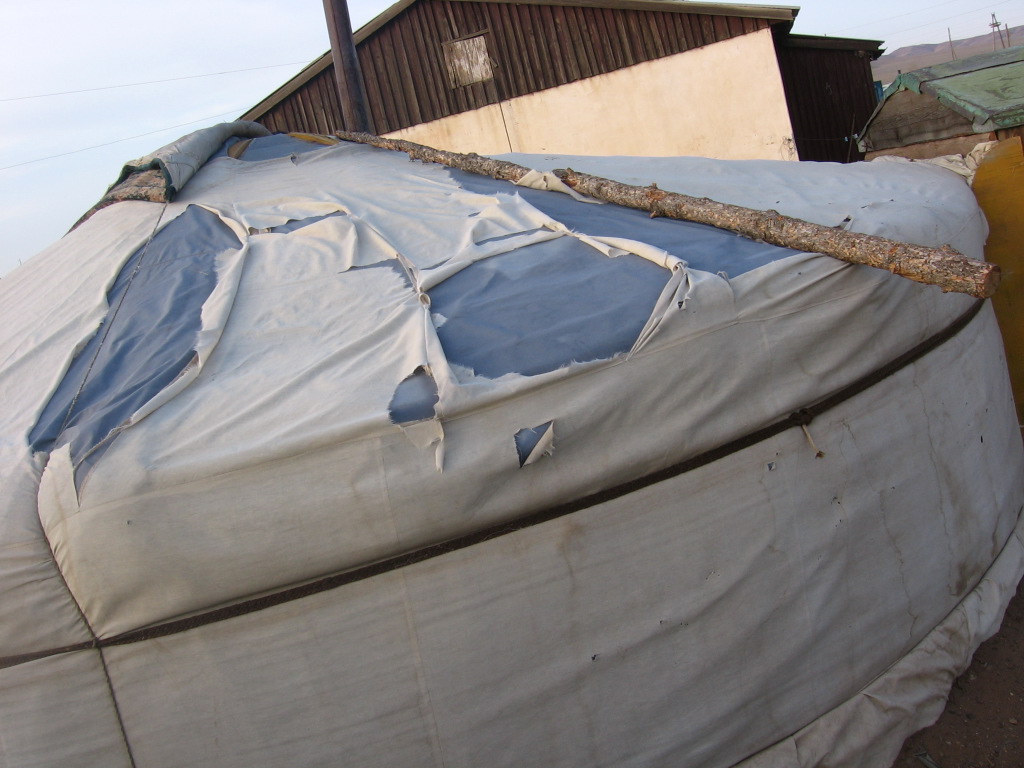
Wind damage to a ger

MWW 16: Хавар


Cyrillic
хавар

Transcription
havar
IPA
[χa.wǝr]
Layman’s
Pronunciation
HAH-wer
Translation
spring
In Genghis Khan’s time it was qabur.


The upcoming улирал is хавар.

хаварших
to become spring

хаваржих
to pass the spring season

хаваржин
during / throughout the spring

хаваржаа
a nomad's spring camp

хаваржаалах
to pass the time in a spring camp (OR, to move to the spring camp?)

хаваржаандаа буух
to take animals to the spring camp (lit., "get down at one's spring camp")

Сайхан хаварж байна уу?
Are you passing the spring well? (a season greeting)

Early spring

Mid spring

MWW 15: Улирал


Cyrillic
улирал

Transcription
uliral
IPA
[ˈʊɬj.rǝɬ]
Layman’s
Pronunciation
OOYL-ral
Translation
season; term
In Genghis Khan’s time it was …?


This word means “season” - such as spring, summer, fall, and winter - but has been generalized to mean various large divisions of the year, such as academic terms - and so it can also be translated as “term,” “quarter,” or “semester.”

улирал эхлэх өдөр
quarter day

хичээлийн улирал
school term (semester, quarter)

улирал бүрийн
quarterly (lit., "every season")

Tuesday, March 27, 2012

How Internet Access Works in a Soum

A large packet of info about the English Olympics came from Peace Corps. Finally! This thing was probably mailed 2 weeks ago. I leafed through it with much interest. There was a lot of stuff that we could have been using already. Instead, we had mostly been drilling them from Test Master 1 and Test Master 2.

“Look at this,” I pointed out to my counterpart. “Some volunteers have put old Olympics tests on the internet.”

“Oh that’s good. Do you think we could use them?”

“Yes. If I could get on the internet. Then I could print them out and make the students do them for practice.”

“Well, maybe you can borrow the modem and find it. I’m going to my seminar now.”

The “Olympics” (In Mongolian, it’s called the Олимпиад) is a yearly academic competition which falls in March or April around the break between the third and fourth secondardy school terms. Schools select 9th and 11th-grade students (and teachers) to compete in a variety of academic subjects. As a Peace Corps TEFL volunteer, it was my duty to work with my counterparts - the other English teachers - to select and train the students who would compete in the English part of the competition.

These old tests could be the most useful prep tool. If I could download them, then transfer them to a flash drive, put them on the school computer, and figure out how to get the printer to work, I could print out copies to give to the students. I could even time them. It’d be like a real English Olympics! We could keep some copies in our TEFL curriculum book and use them indefinitely. The only cost to me would be disinfecting my flash drive from the viruses that were on the school computers.

But first I had to get online. There were three Gmobile modems in my village. One belonged to a photographer, one belonged to the physics teacher, and one was the “school modem,” which got passed back and forth between the training manager and the computer science teacher.

The next day, Thursday, I went in to ask the training manager if I could borrow it. She thought about it, and said she needed it because she had to file reports on all the graduating eleventh graders, spreading out a stack of wordy papers with pictures of my eleventh-grade students, looking criminals in profiles compiled by the police. (Mongolian students graduate after the eleventh grade.) She offered to give me the modem this evening, provided I get it back early the next morning, because she needed to report on the graduates by then.

“Erm.” That wasn’t a whole lot of time. Under any conditions, the connection would be so slow it would take at least that to take care of everything I wanted to do. I told her to go ahead and keep it, and finish her work. I’d take it tomorrow afternoon. She agreed.

“The school kitchen’s closed and your hashaa family’s gone. What are you going to eat?”

“I’ll cook in my ger.”

“Why don’t you have dinner with us tonight?”

“OK.”

Dinner at the training manager’s house was chaotic and noisy, with five young children running around in a small living room kicking over toy cars. One of the boys had a sawed-off plastic rifle.

“What happened to this?” I indicated the missing barrels.

“No, it shoots better that way,” he told me.

Who takes the time to saw off a toy gun?

The evening ended with us lying on our bellies fiddling with Rubix cubes. I managed to solve one, for the first time ever, by the novel method of disassembling and reassembling it. Why has no one thought of this before? Honestly though, it wasn’t actually that much easier than doing it the traditional way. By the time I was done 3 hours had passed.

I told her husband, the art teacher, in passing that I would finish off my chicken tomorrow. He was really excited by the thought of chicken (or probably anything other than mutton) so I invited him for lunch.

The next day I made fried chicken. I called the art teacher but he didn’t answer. After lunch I dropped some chicken off with his kids and went back to school to do more test prep. I didn’t see the training manager around, so on the way home I went back to the house to inquire as to the parents’ whereabouts. Their oldest son shot off some rapid Mongolian explanation of which the only significant word I understood was the name of another county. So, did they skip town?

Back in my ger, I tried to contact the computer teacher, physics teacher, and photographer, but none of them responded, either to calls or text messages. It was quite possible they were all in the countryside somewhere out of range of the network. After all, the break had started so they weren’t obliged to stay put at school. Obviously, I should find something else to do tonight.

To my surprise, the accountant and training manager showed up at my home while I was sawing wood. They helped me saw. T.M. also told me the modem was at school, locked up, and would it be acceptable to borrow it tomorrow? She was very busy. I agreed. No doubt she did need it more than me.

The next day, Saturday, I didn’t see her. The physics teacher showed up at school though. A very sweet young lady, she poked her head in the English classroom to say, “Hi! Good morning!” After the pleasantry I asked if she had her modem. She gave a Mongolian explanation that I didn’t really understand and suggested I ask the TM. I called the training manager.

I was coldly greeted by a recording: “The customer’s phone is turned off.”

“Yaanaa…” The students giggled at my use of a Mongolian interjection.

Later I ran into the TM again, and was again told to wait one more day. I did. On Sunday the TM’s room was locked all day. I ran into her once.

“I’ll give it to you when I go home. There’s so much work to do.”

“Did you eat the chicken?”

“Yes!” She grinned. “It was delicious!”

“Wasn’t it cold by the time you got it?”

“No, it was fine.”

My students went home to lunch but didn’t come back for afternoon study. There wasn’t much for me to do there, so I was about to leave when two 12-year old boys burst into the room with the modem. As I took it they informed me I needed to bring it back to school at 10AM the next day.

I’d used these Gmobile modems a few times before. I hurried home, because I knew it couldn’t get a connection inside the school. It worked much better in my ger. But even then working with it required skill and patience, because at its best, it was minimally acceptable by American standards. The potency of its signal varied greatly depending on location. I’d discovered from experience that the best spot was in the northeast quarter of my ger about 1 meter off the floor. I began stacking boxes on a chair to bring it to the required height.

Previously, I’d had to install the software and configure it. Then, each time I borrowed one of the three different modems, I had to call the owner to help change the username, password, and other settings, blah blah blah. But I’d saved them all now. So I hoped I could get on quickly today. Nevertheless, I knew there were always some false starts before the connection actually worked.

So it was today. The signal still wasn’t very good. Eventually I got a better signal by raising the computer up a few inches. Now I had to use it standing up. But even then the signal wasn’t very good. It took a few false starts to connect successfully. Even when a strong spot is found and the computer is kept still, signal strength fluctuates quite a bit. And if it’s weak to begin with it will spontaneously disconnect after you’ve connected. This is what happened, several times. I jiggled the position of the computer carefully as I tried to connect. After I connected, the speed was still a problem. My homepage is Google, and several times it failed to load because the computer took too long. At one point I accidentally hit “disconnect” on the modem screen. This is bad, because for whatever reason the modem only works the first time you start it. If you try to connect again after closing it, it won’t connect properly and gives you a “retry” message; you have to restart the computer for the modem to reconnect properly. (Thank goodness this doesn’t apply to when the modem disconnects itself randomly.)

I was relieved when Google finally, completely, loaded. It was now a half hour since I’d plugged the modem in. Now I had to go through that again with Gmail. “The remote computer did not respond. Response time timed out. DNS lookup failed. The server sent no data. Please reload later.” When it finally began to load I rushed to click “Load Basic HTML version” or else I would get stuck in email sign-in limbo. When my inbox came up, it was loaded with stuff, most of which I would never read. I checked about 20 items and clicked delete. Uh-oh. The computer couldn’t handle it. I came up with a blank page. I tried reloading the old inbox, but that failed, and when I clicked back all the way to the Google homepage, that failed too. I had to close the browser and go through the process of opening it, loading Google, and loading Gmail again. And for some reason, I immediately tried to delete more email, which messed up my session AGAIN. Why had I been so dumb? This time it took even longer to start up again, with even more failed attempts to load Google and Gmail. I wasn’t counting, but probably 12 or so. Loading a webpage is like a form of gambling. You hope that you’re lucky enough to click on the link at the moment the signal surges; otherwise, I don’t care, it can slack off as much as it wants while I’m merely VIEWING the page.

When I got back on, I merely overlooked the junk and managed to read several emails. One was about some picture posted on Facebook. I couldn’t load the actual picture, but a lot of people had posted that they hated it. I typed a comment, “My connection was too bad to see the picture, but judging by the other comments, I probably wouldn’t like it.” But it wouldn’t post. So I did it again. And then when I loaded the next webpage, I saw,

“This page could not be loaded because you are not connected to the internet.”

What? Sure enough, I had been spontaneously kicked off. And the signal indicator wasn’t even weak. By now, I’d been “using” the internet for 1.5 hours and had managed to read 10 emails. It hadn’t been THIS bad before. When I reconnected I started slowly moving my computer around. My usual policy is never to move the computer once I get a stable connection because the modem is like a spoiled child and even the slightest change will make it throw a tantrum. But the signal was so awful, it was worth doing anything to improve it. Unfortunately, I only managed to lose it completely. I took the computer outside to see if it’d work there. A little better. But not good enough, and it was getting pretty cold.

I thought it was about time I give up, because there was no way I could get on PBWorks to download the tests at this rate. But I started it up one more time in my ger, and BINGO! It worked. The signal was at the strongest I’d seen it. For the next hour or so I surfed, very slowly, but I did achieve a few searches and found some useful information. And then suddenly the connection dropped, again, for no reason. And I still hadn’t gotten those tests downloaded. After I got it going again, my computer froze. I had to restart it. That brought up a blue screen. “An error has occurred. Blah blah blah. Your stuff’s alright though, so just go ahead and press ENTER to continue.”

I started up, but this time there was no indication of a signal. I stared at the icon on my desktop: EasyWirelessNet. “B----,” I thought. There will be no old Olympics tests to practice with.

And that is how internet access works where I am.

Monday, March 12, 2012

This is Your Brain on Fire


My life has changed so much it’s hard to remember how I used to be. It all started when I moved to a strange, unfamiliar place. I had grown up in sunny, warm California. I never worried about staying warm. It just came naturally. But then I joined the Peace Corps and moved thousands of miles away from home to Mongolia. I didn’t recognize anything and didn’t know anyone. I felt out of place, but wished that I could integrate. Little did I know where that would lead.

The first time I used fuel was soon after I arrived at site. My hashaa family had given me a bin filled with sheep dung. At first I was grossed out because, seriously, it came right out of some animal’s butt, but the Mongolians assured me that it was dry and safe to handle. “Just try it,” they said. I decided I would, even though I felt warm enough without it, just because I was eager to be culturally sensitive and didn’t want to disappoint them by turning it down. My hashaa dad showed me how to light the dung. It was just OK, I thought.

I didn’t use any more for a while. Sometimes my hashaa dad came in and made fires for me. Then he told me I should learn to make fires myself. So I started using dung when I was alone, making fires in my ger. First it was a pain in the ass to get used to, but as I got better at it, and could get more flames from my poo, I even started to like making fires. I looked forward to practicing every night.

Later I ran out of dung. The school came to the rescue, but this time they didn’t bring dung, but wood. I mastered wood too. The Mongolians were all excited to see how good I was at starting fires. When I saw how proud they were, I felt happy. Like I belonged now.

I thought that I just did it because I wanted to, and I could control it. But sometimes I burned wood too much, and had to take off my clothes because the ger got TOO hot. Soon I was making a fire every night. Then I started making one in the morning to get going. Finally I lit them in the middle of the day. One day I woke up shivering. I didn’t WANT to make a fire, I NEEDED to make a fire. In desperation I crawled to my stove, fiddling with candles and matches and paper with shaking hands until the wood caught and I breathed a sigh of relief. I was lighting fires more and more, and I was lighting bigger fires. A regular fire just didn’t have the same effect anymore. I felt cold all the time. And when I didn’t have any fire at all, watch out! The first sign was that I could see my breath. Then my toes got numb, I started to shiver uncontrollably, and finally standing water in my ger froze. But most of all, there was an overwhelming, uncontrollable urge to start another fire.

This led to some desperate situations. One day my hashaa family left for UB when my wood ran out. Oh shit, I thought. Oh shit, I thought again. I had to get some fast, but they’d left the saw and axe inside their locked house. I’d never been a beggar, but that gray afternoon I went from neighbor to neighbor until someone gave me their tools, and miserably I sawed away, with a handle-less two-person saw. But when I finally set the match to that magnificent timber, I felt all the effort had been worth it.

But even wood wasn’t enough. One morning I woke up and the water in my boiler-thingy, that I’d just boiled the night before, was ice. I talked to my hashaa family. They asked if I’d ever tried the hard stuff. You know. Coal.

I didn’t want to do coal. I’d always thought coal was ugly, dirty, and dangerous. I’d seen it used on the streets of UB. I’d heard stories about people even dying from CO poisoning. But at that moment I was so desperate to stay warm I didn’t care, and said yes. After all, when I looked around, all the people in my sum were doing it, and they were all right, right?

Now most nights I sit in my room, hoping that my smoke detector’s batteries don’t die at just the wrong moment. My hands and coat are dirty from coal dust and I bet smoke inhalation is the reason I’m coughing now. Sometimes I wonder what my friends and family would think. Everything I’d believed in and held dear - moderation, non-pollution, renewable resources - all of that went down the drain. I betrayed it all for just a few hours of warmth. Right now I’m warm and it’s easy to say I can deal with a little cold. But deep inside I know that in a few hours, once the shivering starts, I’ll reach for my lighter and coal bin like always.

My advice to you is, don’t make the same mistake I did. It’s much easier never to start. I know. I wish that I could quit. Just say “no” to coal.

Women's Day


Last Thursday, March 8, was Women’s Day (Эмэгтэйчүүдийн Баярын Өдөр) in Mongolia. As could be expected it was celebrated with lots of food and vodka and dancing teachers. Dancing teachers in themselves are worthy of a blog post. Never since I came here have I wished I had a video camera as much as when I saw a bunch of middle-aged Mongolians in suits raving to a techno version of the Für Elise. However I’d like to take this opportunity though to point out why we should celebrate Mongolian women, because it is women who run the country. Women here are teachers, governors, doctors, lawyers, business owners - in fact, they are overrepresented in nearly every profession. Why is this?

Part of the reason has to do with Mongolia’s traditional economy. Until recently in history, almost everyone in the country herded animals or was a Buddhist monk. Both boys and girls do work in herding families, but the boys’ role is greater. When the Socialists dumped a national education system on Mongolia, most families figured that if there were going to educate one of their kids, they would send the daughter, and keep the son home to do manly ranch work. So more women finished school, more women went to college, and more women got jobs. When the professional sector appeared, it was filled with women. A substantial part of the population is still involved in herding, so the trend continues.

The gap begins early. In  my upper grade classes, there are always more girls than boys. One class has 6 boys and 19 girls. Mongolians aren’t giving birth to girls at a 4:1 ratio over boys. The boys are dropping out of school.

My school has 36 faculty (at least on the contact info sheet). 8 of them (including me) are men. The other 28 are women. That means they outnumber us almost 4 to 1. Moreover, the really powerful positions are all women. The school director (principal / superintendent) is a woman, as are both of the training managers (the teachers’ immediate bosses, who oversee them and approve all lesson plans). Our past few directors and training managers were also women. Of 4 doctors I’ve met, 3 are women. Our soum governor is a woman. Men are shepherds, drivers, handymen, watchmen, miners, welders, stokers, etc. - mostly shepherds. Or they’re unemployed. Only when you get to the very top (parliamentary representatives, for example) do men dominate again.

One consequence of this is relationships in Mongolia are very mismatched status-wise. In most countries people marry people of equivalent education and income. If they don’t, it’s usually the man who’s higher status. In Mongolia it’s very much the opposite. Women are usually better-educated and make more money than their husbands. Of the male teachers I mentioned above, 4 are married to other teachers, 1 is dating another teacher, 1 is dating a student (a UNIVERSITY student, if you were wondering), and 1 is married to the governor (even the governor can’t resist a sexy teacher). Obviously 23 of the women are going to be unable to marry another teacher. One is married to a bank clerk and the rest that I know about are married to herders, drivers, and school workers (not teachers). One of our teachers, who went to the National University of Mongolia (the top school in the country), is married to one of the men who, if I recall correctly, maintains the furnace at school, and who presumably never went to college. In the US it would be really bizarre for an Ivy League graduate to marry a guy without any college education. But it happens in Mongolia.

Nevertheless, everybody is married. Why aren’t there instead a bunch of lonely old teachers dreaming of an equitable match? Because in Mongolia everyone wants you to get married, now. People here (in the countryside) tend to marry by their early twenties, marry the first person they date, and marry quickly (i.e., we’ve been dating for 4 months, let’s get married). Ironically, this is fueled by the lack of educated men, because everyone is in a hurry to put a lock on the first decent man they meet. It’s like an arms race, except instead of being the first person to detonate a nuclear weapon, you must be the first person to marry that guy who just came back from the city with a degree. If you can’t, you find a nice guy among the herdsmen, lest you end up with an unemployed alcoholic (which are unfortunately common in many places).

Of all those 36 teachers, only 2 are neither married nor engaged: myself and one 26-year-old woman. Unsurprisingly, a few teachers have begun to ask if I would marry her. They could be joking, but I’m not sure. What sane woman, already past her early twenties, would not jump at the golden opportunity of a man with a degree and job being dumped right next to her? (In any case, she herself has shown no interest in me.)

So let’s celebrate women and all the hard work they do, and hope more men get their act together!

MWW 14: Хадаг


Cyrillic
хадаг

Transcription
hadag
IPA
[χa.tǝk]
Layman’s
Pronunciation
HAH-duck
Translation
silk scarf
In Genghis Khan’s time it was qadaγ.


A хадаг (hadag - often transliterated khadag) is a silk scarf that has ritual significance in Mongolia. Usually they’re the color of a summer’s sky - or the Word-of-the-Week table above. There are also golden-yellow ones (for religious offerings), white ones (for high honors), and red and green ones. They also sport Mongolian designs whose cultural significance I can’t begin to speculate on.
Hadag of different colors

Хадаг play a part in many ceremonies. During Tsagaan Sar, they’re usually presented to one’s elders. They also appear in welcoming ceremonies. When I first arrived at my training site and at my permanent site, I was given a хадаг (and a bowl of айраг). Once you get a хадаг, though, it’s yours; you can’t reuse one someone gave you as a gift to someone else. You can give it to nature though. Хадаг are frequently seen in large numbers tied to (sacred?) trees or to овоо. I’ve also seen drivers with хадаг spread across the top of the windshield, held up by the shades / mirror.

Close up of a hadag

Hadag can be tied to just about anything worthy of recognition - in this case, a  ram sculpture on a rock outcrop  overlooking the road near Tsetserleg, Arkhangai Province.